


Beyond Pretty Pictures: Webb's Infrared Advantage
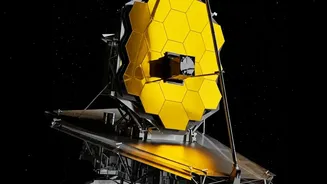
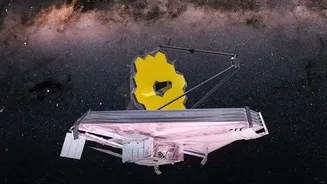
The James Webb Space Telescope (JWST) is more than a successor to Hubble; it's an entirely different kind of observatory. While Hubble primarily saw the universe in visible and ultraviolet light, JWST is an infrared powerhouse, designed to detect the faint
heat signals from the dawn of time and, crucially, from celestial bodies that are too cool to glow brightly on their own. This infrared sensitivity is the key to its exoplanet-hunting prowess. It allows the telescope to cut through cosmic dust and capture the chemical makeup of worlds hundreds of light-years away. This capability transforms the search for alien worlds from simply spotting them to truly beginning to understand them.
Decoding a Planet's Breath
So, how does Webb 'read' an atmosphere from trillions of kilometres away? The primary method is called transit spectroscopy. As an exoplanet passes in front of its host star from our point of view, a tiny fraction of the starlight filters through the planet's atmosphere. The gases present in that atmosphere absorb specific wavelengths, or colours, of infrared light. This process leaves a unique chemical fingerprint imprinted on the starlight that reaches Webb's sensitive instruments. Scientists can then analyse this 'spectrum' to identify the molecules present, like water, methane, or carbon dioxide. It's akin to identifying the ingredients in a recipe by seeing which colours of light are missing from a rainbow.
A Gallery of Alien Atmospheres
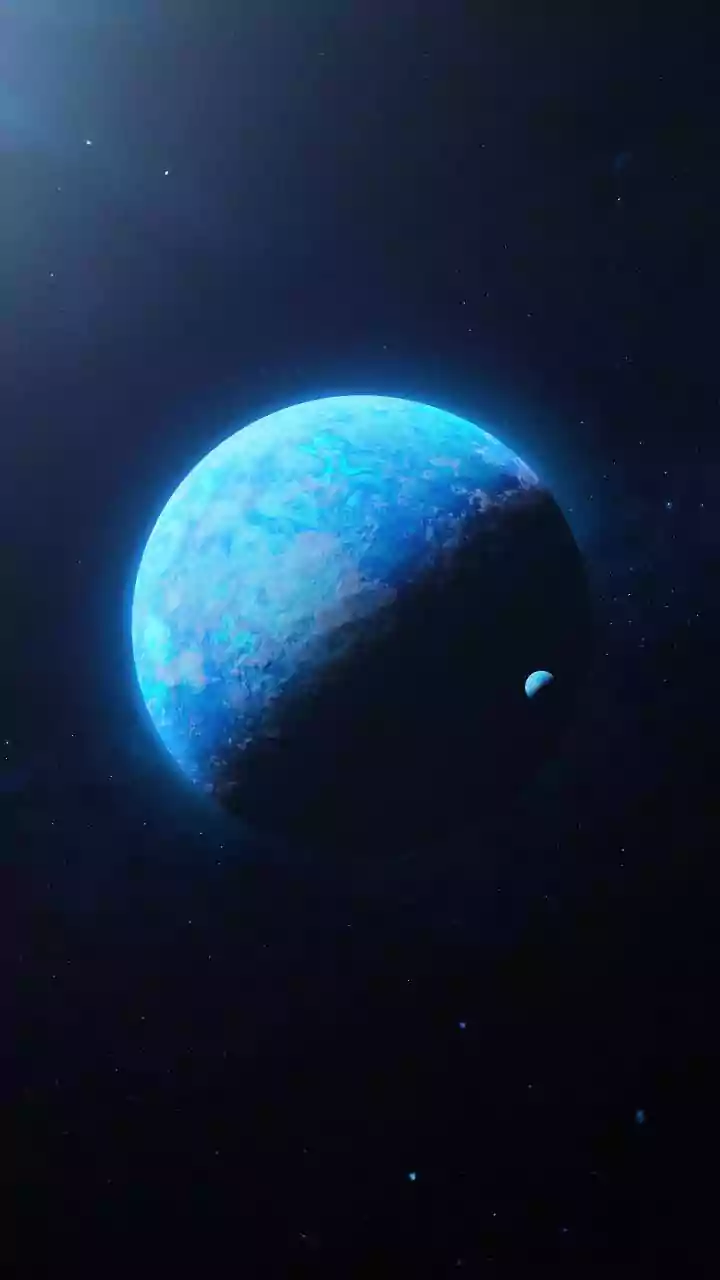
Since beginning operations, JWST has already provided a stunning portfolio of atmospheric compositions. On the hot, Saturn-like planet WASP-39b, it delivered a full menu of atoms and molecules, including the first-ever detection of sulphur dioxide in an exoplanet's atmosphere—a molecule created by the star's light triggering chemical reactions. For the temperate, Saturn-sized world TOI-199b, Webb found an atmosphere containing methane, with hints of ammonia and carbon dioxide. One of the most intriguing targets has been K2-18 b, a 'sub-Neptune' planet located 124 light-years away in its star's habitable zone. Webb confirmed the presence of carbon-bearing molecules like methane and carbon dioxide, supporting the theory that it could be a 'Hycean' world—a planet with a hydrogen-rich atmosphere and a water ocean. This diversity of findings showcases the telescope's power to characterize planets unlike anything in our own solar system.
The Cautious Hunt for Biosignatures
The ultimate goal of studying exoplanet atmospheres is the search for biosignatures: gases that suggest the presence of life. Webb's observations of K2-18 b caused a stir with the possible detection of dimethyl sulphide (DMS), a molecule that on Earth is predominantly produced by marine life like phytoplankton. However, scientists remain extremely cautious. Such a detection is still tentative and must be confirmed with many more hours of observation to rule out other chemical or geological sources. Finding a potential biosignature is not proof of life, but rather a compelling reason to look much, much closer. The process demonstrates the immense challenge of the search; even with Webb's power, distinguishing a true biological signal from a planetary false positive is a monumental task.