





The Physics of a Fiery Fall
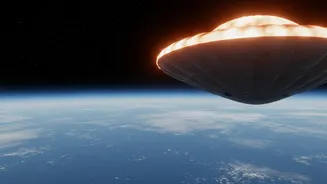
Any object entering an atmosphere from space is travelling at incredible speeds—up to 29,000 kilometres per hour or even faster. Slamming into the air at that velocity creates immense friction and compresses the air, generating a surrounding sheath of
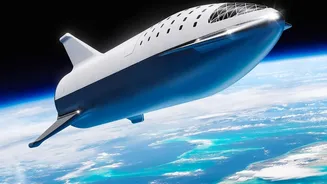
plasma hotter than lava, easily exceeding 1,600 degrees Celsius. Without protection, a spacecraft would simply vaporize. For decades, the solution has been a rigid, blunt-nosed heat shield. These aeroshells, made of ablative materials that burn away or ceramic tiles that radiate heat, have protected everything from the Apollo capsules to the Mars rovers. But they have a fundamental limitation: they must fit inside the rocket fairing that carries them into space. This size constraint limits how much mass can be safely landed, a major hurdle for ambitious deep-space missions.
Thinking Outside the Rocket Fairing
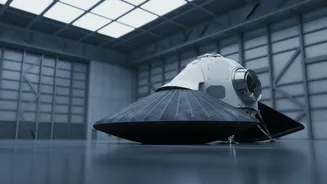
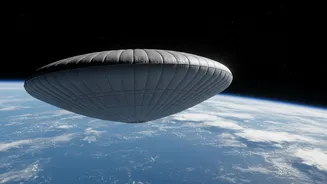
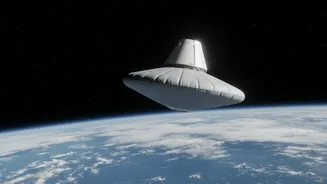
This is where the inflatable heat shield comes in. The concept, officially known as a Hypersonic Inflatable Aerodynamic Decelerator (HIAD), is simple in principle but revolutionary in practice. Instead of a fixed-size shield, a HIAD is packed into a small container for launch. Once in space, it inflates like a high-tech air mattress, expanding to a diameter much larger than the rocket fairing could ever allow. This larger surface area creates significantly more drag, allowing the spacecraft to begin slowing down much higher in the atmosphere where the air is thinner. This gentle, high-altitude deceleration dramatically reduces the peak heating and stress the vehicle experiences during its final descent.
More Than Just a Balloon
An inflatable heat shield is far from a simple balloon. It is a highly engineered system built from advanced materials designed to endure extreme conditions. The structure is typically a stack of concentric rings, or tori, woven from synthetic polymer fibres that are, by weight, stronger than steel. These are inflated with nitrogen or another gas to form a rigid, stable shape. The crucial outer layer, the flexible thermal protection system, is made of a woven ceramic fabric, such as silicon carbide. This material can withstand the scorching temperatures of re-entry. Underneath this outer layer are multiple layers of flexible insulation that prevent the intense heat from reaching the inflatable structure and the precious payload within.
LOFTID: A Successful Test Run
The technology took a major leap forward with NASA’s Low-Earth Orbit Flight Test of an Inflatable Decelerator, or LOFTID. In a 2022 test, a 6-metre diameter inflatable aeroshell was launched into space, inflated, and sent on a re-entry course back to Earth. It slammed into the atmosphere at nearly Mach 24, endured the fiery plunge, and successfully slowed itself from over 29,000 km/h to less than 130 km/h, allowing for a parachute-assisted splashdown in the Pacific Ocean. The recovered vehicle was in excellent condition, proving that the inflatable structure and its thermal protection system could survive the brutal forces and temperatures of orbital re-entry.
Unlocking the Future of Deep-Space Exploration
The success of LOFTID is a game-changer, especially for future missions to Mars. Landing humans on the Red Planet, or even just returning large Martian rock samples, requires landing much heavier payloads than is currently possible. Mars's thin atmosphere makes slowing down particularly challenging. A large-diameter inflatable shield can create the necessary drag to land habitats, ascent vehicles, and other heavy equipment safely on the surface, including at higher-elevation landing sites that are currently inaccessible. This technology is not limited to Mars; it could be used for missions to Venus, Saturn's moon Titan, or for cost-effectively returning large assets from Earth orbit.