




A New Chapter for a Legendary Probe
Japan's Hayabusa2 became a household name after it successfully rendezvoused with asteroid Ryugu, deployed rovers, and returned precious samples to Earth in December 2020. The materials, containing organic molecules and water, offered clues about the
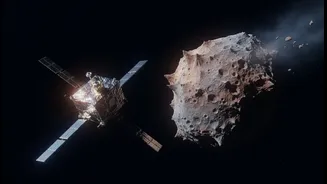
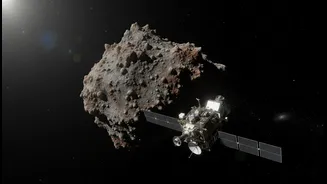
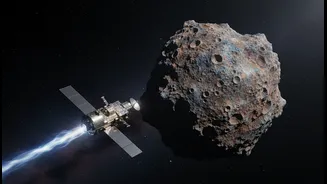
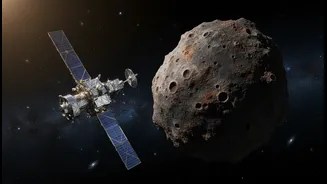
building blocks of our solar system and life itself. But for the tough little explorer, that was just the beginning. With plenty of fuel left in its efficient ion engines, the Japan Aerospace Exploration Agency (JAXA) sent Hayabusa2 on an extended mission. The first major milestone was the close encounter with a new target: a 450-meter-wide near-Earth asteroid named Torifune, also known as 2001 CC21.
Meet the Target: Asteroid Torifune
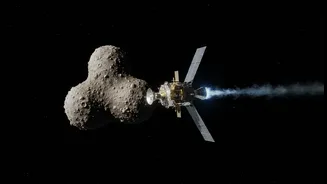
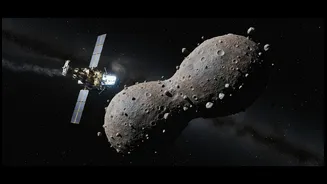
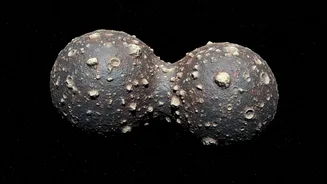
Torifune was chosen for this flyby for several reasons. It belongs to the Apollo group of asteroids, whose orbits cross Earth's, making them objects of interest for planetary defense. The name, meaning "bird-ship" in Japanese mythology, was chosen to reflect the hope for a safe, high-speed encounter. And high-speed it was. The spacecraft zipped past at a relative speed of about 5 kilometers per second. Images captured during the flyby revealed Torifune is a "contact binary" asteroid, appearing like two distinct lobes stuck together, sometimes called a "snowman" shape. This flyby was a crucial test of JAXA's ability to observe a fast-moving object up close, a skill vital for future missions.
The Immense Challenge of Deep Space Navigation
Hitting a target in the vastness of space is an incredible challenge. There is no GPS. Your target is a relatively small, dark object millions of kilometers away, and its exact path isn't perfectly known. The flyby of Torifune required the spacecraft to pass within about 800 meters of the asteroid's center—a remarkably tight window. To make it even harder, Hayabusa2 was not originally designed for this kind of high-speed flyby; its cameras are optimized for observing an object after arriving and rendezvousing. This meant the final, critical navigation adjustments had to be made in the last few days leading up to the encounter.
The Toolkit: How Precision Navigation Works
So how did they pull it off? It’s a combination of smart technology and teamwork between the probe and its controllers on Earth. The primary tool is optical navigation. In the weeks leading up to the flyby, Hayabusa2 used its Optical Navigation Camera to take images of Torifune against the background of distant stars. By analyzing the asteroid's position relative to these fixed points, operators at JAXA, working with NASA's Deep Space Network, could calculate the spacecraft's trajectory with increasing accuracy. They then sent commands to the spacecraft, which used its highly efficient ion engines to make tiny, precise course corrections. This process was repeated constantly, refining the path until the final moments before the flyby, demonstrating a level of control JAXA says is similar to technologies needed to intentionally collide with an asteroid.
Why This Flyby Matters
The Torifune encounter was far more than a scientific pitstop. JAXA viewed it as a critical technology demonstration for planetary defense. Learning how to precisely guide a spacecraft to a small, fast-moving asteroid is a necessary step for developing methods to deflect a potential future impactor. This flyby served as a rehearsal for future rapid reconnaissance missions and a dress rehearsal for Hayabusa2's ultimate goal in 2031: a rendezvous with the tiny, ultra-fast-rotating asteroid 1998 KY26. That encounter will push the probe's capabilities to their absolute limit. The skills honed at Torifune are what make these future, more ambitious explorations possible, pushing the boundaries of what humanity can achieve in the cosmos.