



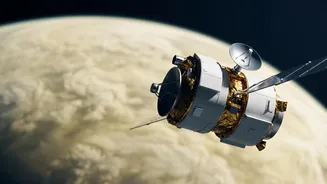

India's Next Interplanetary Frontier
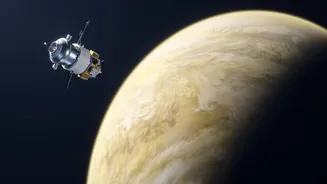
Following the historic successes of Chandrayaan's lunar missions and the Mangalyaan Mars orbiter, the Indian Space Research Organisation (ISRO) is setting its sights on our other planetary neighbour: Venus. The planned Venus Orbiter Mission, named Shukrayaan-1,
represents India's first dedicated mission to the second planet from the Sun. Formally approved by the Indian government in September 2024, the mission is now in an advanced stage of development. According to recent reports and official timelines, ISRO is targeting a launch window in March 2028. This ambitious project places India among a select group of space agencies actively preparing to revisit Venus, aiming to contribute significantly to our understanding of this enigmatic world.
Why Venus? Earth's Cautionary Tale
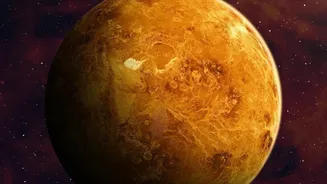
At first glance, Venus is Earth's twin; it's similar in size, mass, and composition. But it evolved into a planetary catastrophe. Venus suffers from a runaway greenhouse effect, where its incredibly thick carbon dioxide atmosphere traps heat, raising surface temperatures to a scorching 467 degrees Celsius—hot enough to melt lead. Its atmospheric pressure is over 90 times that of Earth's at sea level. Scientists are fascinated by Venus because it offers a natural laboratory for studying how a planet so similar to our own could become so inhospitable. Understanding the processes that led to Venus's current state could provide crucial insights into climate change dynamics and the long-term future of Earth's own atmosphere.
Decoding the Corrosive Clouds
One of the most defining and dangerous features of Venus is its thick, perpetual cloud cover. These aren't clouds of water vapour like on Earth; they are composed primarily of highly corrosive sulfuric acid droplets. This toxic haze completely obscures the planet's surface from view and presents a major engineering challenge for any visiting spacecraft. These acidic clouds are a key focus for Shukrayaan-1. The mission intends to study their chemistry, structure, and dynamics in real-time. Scientists believe that analysing the composition of these clouds is essential for understanding the planet's weather, its mysterious atmospheric "super-rotation" (where the atmosphere circles the planet far faster than the planet itself rotates), and the complex chemical cycles that sustain this extreme environment.
The Technology to Pierce the Veil
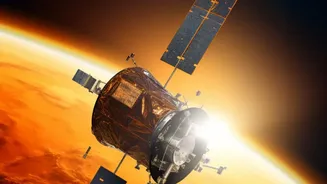
To achieve its scientific goals, the Shukrayaan orbiter will be equipped with a suite of sophisticated instruments. The mission plans to carry around 19 payloads, including contributions from international partners like Sweden, Russia, and France. Among the key Indian instruments are a Mass Spectrometer to analyse atmospheric composition and a Venusian Neutrals Analyzer (VNA) to study the interaction between solar wind and the planet's atmosphere. The headline capability of measuring cloud chemistry will be handled by payloads like the Venus Infrared Atmospheric Gases Linker (VIRAL), a collaborative Russo-French instrument. The spacecraft will also carry a high-resolution Synthetic Aperture Radar (SAR) to penetrate the dense clouds and map the planet's volcanic surface in unprecedented detail, along with a ground-penetrating radar to study its subsurface geology for the first time.
A Renewed Global Focus on Venus
ISRO's mission is part of a new wave of international interest in Venus. For decades, the planet was largely overlooked in favour of Mars and the outer solar system. Now, several agencies are planning to return. NASA is developing two major missions, VERITAS and DAVINCI, scheduled to launch in the 2028-2031 timeframe. The European Space Agency (ESA) also has its EnVision orbiter planned for the early 2030s. Shukrayaan-1 is poised to arrive ahead of some of these missions, positioning India as a key player in this renewed era of Venus exploration. The mission's focus on atmospheric chemistry and subsurface mapping will provide complementary data, ensuring that the global scientific community gains a more holistic view of Earth's mysterious twin.