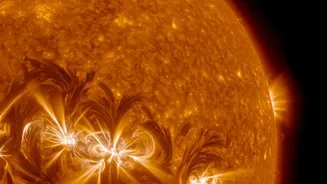


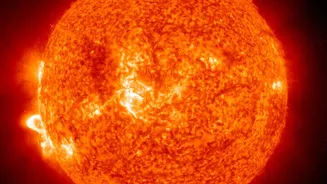
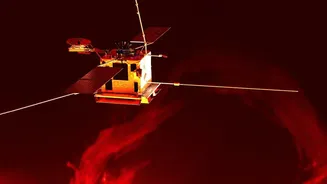
Our Sun is both a life-giver and a source of violent outbursts. For the first time, a partnership between India’s Aditya-L1 and Europe's Proba-3 missions is giving us a revolutionary look into these eruptions, a breakthrough for science.
A Tale of Two Trailblazers
At the heart of
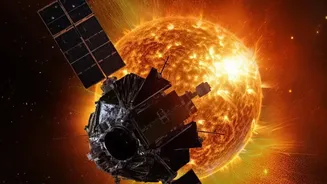
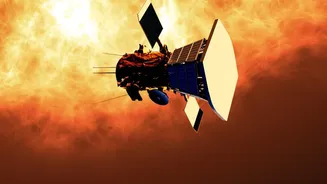
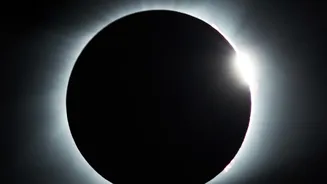
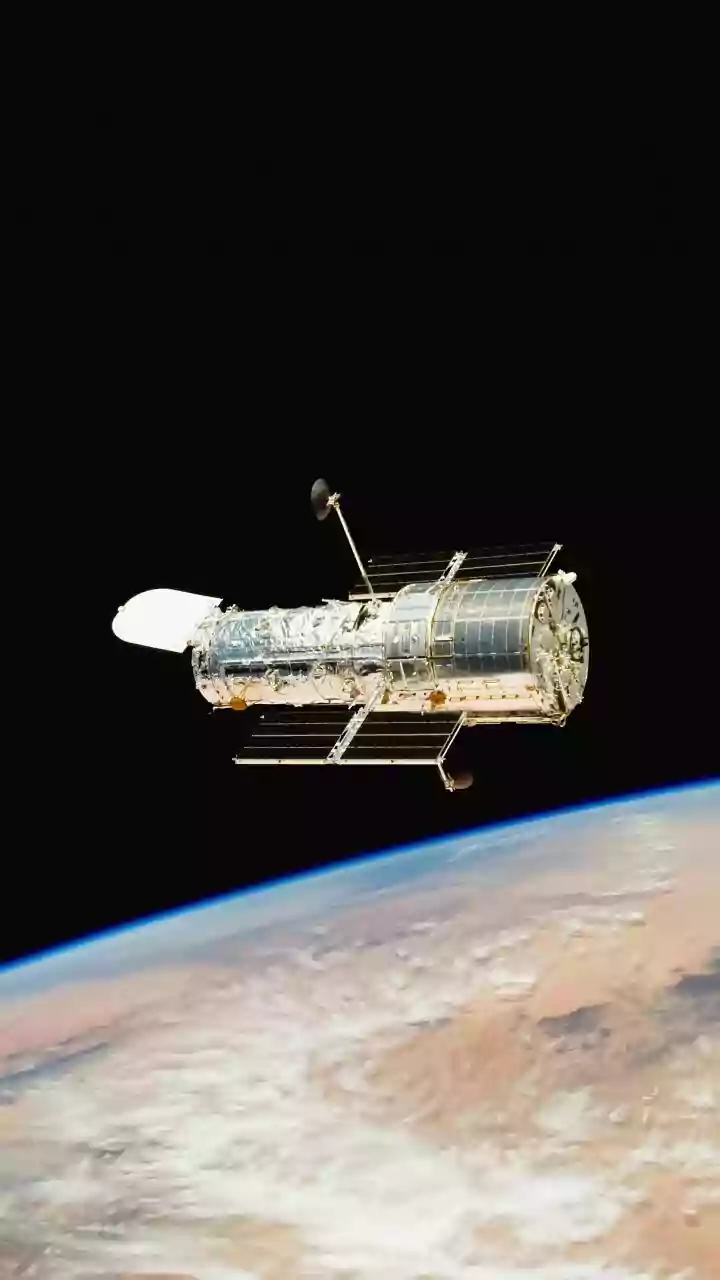
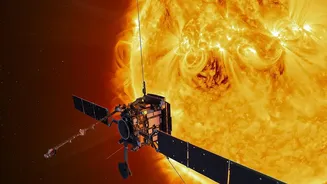
this discovery are two remarkable space missions. India's Aditya-L1 is the nation's first dedicated solar observatory, strategically positioned 1.5 million kilometres from Earth at a unique spot called Lagrange Point 1 (L1). This vantage point allows it to watch the Sun continuously without any interruption from eclipses. Meanwhile, the European Space Agency's (ESA) Proba-3 is a pioneering mission demonstrating a world-first: precision formation flying. It consists of two separate satellites flying in perfect tandem, about 150 metres apart, to create a precise, long-duration artificial eclipse in space. This allows its instruments to study the Sun's faint outer atmosphere, or corona, which is usually blinded by the star's intense glare.
The Challenge of Solar Eruptions
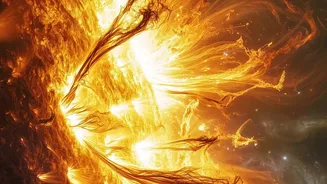
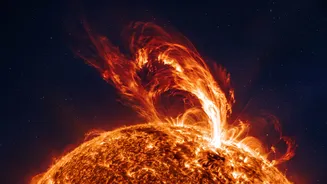
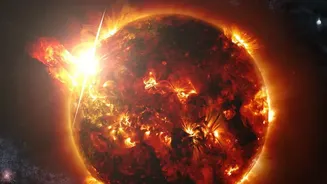
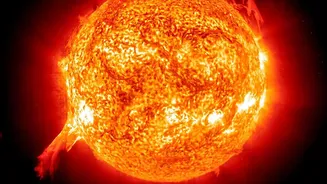
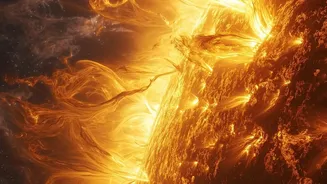
The Sun frequently unleashes what are known as Coronal Mass Ejections (CMEs). These are colossal explosions of magnetised plasma and charged particles hurled into space at incredible speeds. While many miss our planet, those directed towards Earth can trigger powerful geomagnetic storms. These storms pose a significant threat to our modern, technology-dependent world, capable of disrupting satellites, damaging power grids, and interfering with GPS and communication networks. For decades, scientists have struggled to measure the properties of CMEs—like their mass and density—in their earliest stages, close to the Sun. This missing information has been a major hurdle in accurately predicting their journey through space and their potential impact on Earth.
A Partnership Forged in Space
The collaboration between Aditya-L1 and Proba-3 provides the solution. It's a textbook case of international scientific synergy, where the whole is far greater than the sum of its parts. Proba-3’s two satellites create a perfect artificial eclipse, allowing its coronagraph, ASPIICS, to capture incredibly detailed images of CMEs as they erupt. At the same time, from its distant L1 viewpoint, Aditya-L1's primary instrument, the Visible Emission Line Coronagraph (VELC), performs a different task. It conducts spectroscopic analysis, breaking down the light from the eruption to determine the plasma's temperature, velocity, and density. By combining the high-quality imaging from Proba-3 with the spectroscopic data from Aditya-L1, scientists can build a comprehensive, three_dimensional picture of an eruption.
The Breakthrough Measurement
In a study published in the journal 'Astronomy & Astrophysics', researchers from the Indian Institute of Astrophysics and international partners detailed their joint analysis of two CMEs that occurred in September 2025. For the first time, they successfully combined the data from both missions to precisely calculate the mass, density, and energy of the eruptions near the Sun. The findings confirmed that different parts of a CME can expand at different speeds, resulting in an uneven shape rather than a uniform balloon_like expansion. This is a crucial insight, as the structure and density of a CME determine how it will travel and interact with Earth's magnetic field. The agreement between the two independent sets of measurements gives scientists high confidence in the results.
Protecting Our Digital World
This achievement is more than just an academic exercise; it has profound real_world implications. A better understanding of the fundamental physics of solar eruptions directly leads to more accurate space weather forecasting. Knowing the mass and density of a CME at its birth allows for much more reliable predictions of its arrival time and potential strength. This advanced warning gives satellite operators, power grid managers, and airlines crucial time to take protective measures, mitigating potential damage and ensuring the stability of the infrastructure we rely on every day. This partnership not only showcases India's leadership in space science but also highlights how global collaboration is essential for tackling challenges that affect us all.