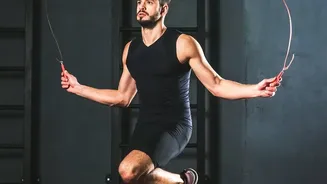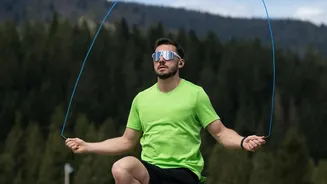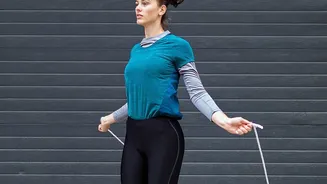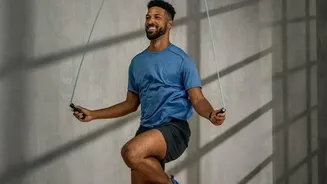





An Endurance and Calorie-Burning Powerhouse
Why has this simple tool been a long-time staple for athletes, especially boxers? The answer is efficiency. Jumping rope is a high-intensity workout that skyrockets your heart rate, enhancing your cardiovascular health and stamina. It's a full-body workout that engages
your lower body, core, and even your arms and shoulders. This level of muscle engagement leads to significant calorie burn, with some estimates suggesting you can burn over 10 calories per minute. Beyond cardio, skipping is a form of plyometric training that builds muscle power, improves coordination, agility, and balance, all of which contribute to overall athletic performance.
Choosing Your First Jump Rope
The rope you choose can make a big difference, especially for a beginner. While any rope is better than no rope, many beginners find that ultra-light, cheap PVC ropes are difficult to control because they don't provide enough feedback. A slightly heavier rope, often called a 'beaded rope' or a weighted rope, can actually make learning easier because you can feel the rope rotating, which helps with timing your jumps. The most critical factor, however, is length. To find the right size, stand on the middle of the rope with both feet. The ends of the cable (not including the handles) should reach your armpits. A rope that's too long will drag and slow you down, while one that's too short will trip you up constantly.
Mastering the Basic Form
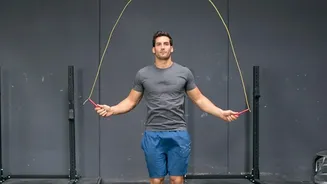
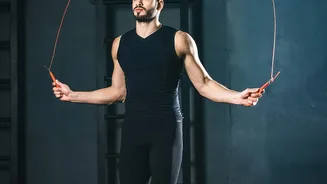
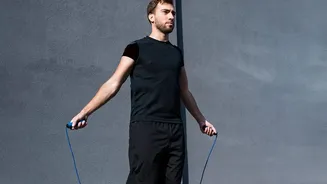
Good form is essential to prevent injury and make your practice effective. Stand up straight with a neutral spine, relaxed shoulders, and your eyes looking forward. Keep your elbows close to your body, almost tucked into your sides, and your hands near your hips. The rotation of the rope should come from your wrists making small circles, not from big swings with your arms. Your jumps should be small and low to the ground—just high enough to clear the rope. Land softly on the balls of your feet with your knees slightly bent to absorb the impact. Avoid landing flat-footed or on your heels.
Common Mistakes to Sidestep
Many beginners share the same few struggles. The most common is jumping too high, sometimes with a small 'double bounce' between each rope rotation. This is inefficient and tiring. Focus on a single, small bounce for each turn of the rope. Another frequent error is using your entire arms to swing the rope instead of just your wrists. This wastes energy and disrupts your rhythm. Keep your elbows in and let your wrists do the work. Also, check your posture. Avoid arching your back or looking down at your feet; keep your chest up and core engaged.
A Beginner's Endurance Workout
Consistency is more important than intensity when you start. A great way to build endurance is with interval training. Don't try to jump for 10 minutes straight on your first day. Instead, try this simple routine: Warm up for 3–5 minutes with light jogging in place and arm circles. Then, alternate between 30 seconds of jumping rope and 30 seconds of complete rest. Repeat this cycle for 5 to 10 minutes. As you get more comfortable, you can gradually increase the work time (e.g., to 40 seconds) and decrease the rest time (e.g., to 20 seconds).
How to Progress Your Practice
Once you've mastered the basic bounce and can comfortably complete interval workouts, you can start challenging yourself to build even greater endurance. The first step is to increase the duration of your sessions. Try adding a few minutes to your total workout time each week. Next, you can introduce new footwork patterns. Instead of the two-footed bounce step, try the alternate–foot step, which mimics running in place. This is excellent for building coordination and endurance. From there, you can explore more advanced moves like high knees or even work toward the challenging 'double under', where the rope passes under your feet twice in a single jump.