






An Orchestra of Observation
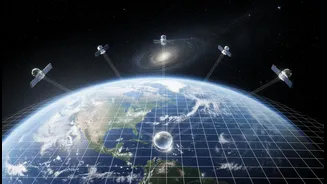
Imagine an orchestra where every instrument is slightly out of tune. The result would be a confusing and unreliable sound. For decades, scientists have faced a similar problem with the vast fleet of Earth-observing satellites. Sent into orbit by different
agencies at different times, each satellite's sensors have their own unique quirks and biases. Furthermore, the harsh environment of space causes these sensitive instruments to degrade over time, a drift that can be hard to track. These tiny inconsistencies add up, creating uncertainty in long-term climate data. When trying to measure subtle but critical changes in Earth's temperature or reflectivity over decades, even a small measurement error can make it difficult to distinguish a true climate trend from simple sensor drift. This challenge has been a major hurdle in climate science, making it harder to validate models and build a completely unified picture of our planet's health.
A Tuning Fork in Space
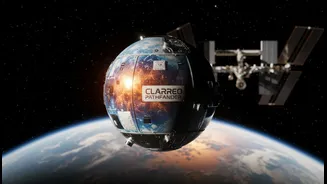
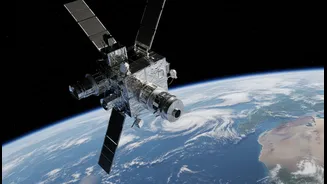
This is where NASA’s CLARREO Pathfinder (CPF) comes in. Launched to the International Space Station in May 2026, CPF is not just another satellite; it's a new kind of reference instrument. Think of it as the orchestra's tuning fork. Its job is to provide a single, highly accurate benchmark that other satellites can be compared against. The instrument, a hyperspectral imager, measures sunlight reflected from the Earth and the Moon with five to ten times more accuracy than any sensor before it. By pointing at the sun, a well-known constant, it can continually calibrate itself, ensuring its measurements remain trustworthy over its entire mission. This makes it the first on-orbit reference standard that is directly traceable to international measurement standards, essentially a gold standard for climate observations floating in space.
From Disagreement to Trustworthy Data
The true power of CLARREO Pathfinder lies in what it enables other satellites to do. As CPF orbits the Earth, its path will cross with other crucial climate-monitoring satellites, such as the CERES and VIIRS instruments. During these crossover events, both CPF and the target satellite will view the same patch of Earth at nearly the same time. By comparing the data, scientists can precisely identify and correct for any biases or drift in the other satellite's sensors. This process, known as intercalibration, effectively tunes the entire fleet of Earth-observing instruments to the same standard. The result is a more cohesive, reliable, and high-fidelity dataset stretching back decades. This allows scientists to detect subtle climate trends much sooner and with far greater confidence, removing nagging doubts about whether the data reflects reality or just instrument error.
The Pathfinder's Journey and Future
As a "Pathfinder" mission, this one-year deployment on the ISS is designed to prove the technology and the intercalibration method. After its launch in May, the instrument achieved "first light" in the summer of 2026, successfully capturing its initial science data and validating that the hardware was working perfectly. The first images, taken over Canada, showed the instrument's power to capture incredibly detailed information about clouds, land, and ocean surfaces across hundreds of spectral bands. The success of this demonstration is a critical step recommended by the National Academies and could pave the way for a future, more comprehensive CLARREO mission. By proving it can create this on-orbit benchmark, CPF is not only enhancing the value of existing billion-dollar satellite assets but also building a new foundation for the future of climate science.