



The Junkyard Above Our World
Low Earth Orbit (LEO), an orbital band extending up to about 2,000 kilometres, is a critical resource for humanity. It hosts thousands of satellites that power our daily lives, from weather forecasting and telecommunications to global positioning systems.
But for decades, we have treated this finite space like an infinite landfill. Every satellite launch, every mission, and every accidental collision has left something behind. Today, LEO is cluttered with millions of pieces of 'space junk'. According to NASA, there are over 34,000 objects larger than 10 centimetres, but the real danger lies in the estimated 128 million smaller fragments. These objects range from defunct satellites and spent rocket stages to tiny flecks of paint and metal shards. And they are not floating idly; they are travelling at incredible speeds of up to 28,000 kilometres per hour, ten times faster than a bullet.
The Danger of a Single Fleck
At orbital velocities, even a minuscule piece of debris carries immense kinetic energy. A paint chip can blast through the hull of a spacecraft, and a marble-sized fragment can disable an active satellite worth hundreds of millions of dollars. The International Space Station has had to perform manoeuvres to dodge debris, and the risk to astronauts is a constant concern. The greatest fear among scientists is a scenario proposed by NASA scientist Donald J. Kessler in 1978. The 'Kessler Syndrome' describes a cascading chain reaction where a single collision creates a cloud of new debris, which in turn causes more collisions, creating even more debris. This could eventually render entire orbital altitudes unusable, trapping humanity on Earth and cutting off the space-based services we depend on. To prevent this, space agencies and commercial companies are racing to develop methods for Active Debris Removal (ADR).
Enter the Orbital Cleanup Crew
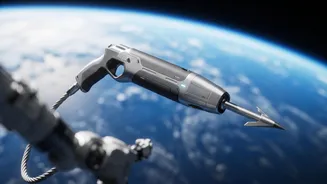
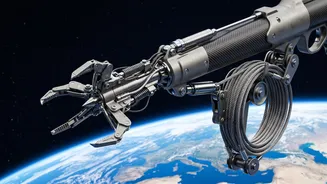
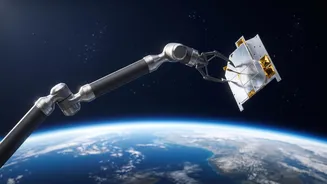
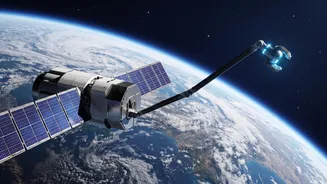
Cleaning space isn't as simple as sending up a garbage truck. The targets are small, widely dispersed, and moving at immense speeds. A variety of ingenious solutions are being developed, including robotic arms, giant nets, harpoons, and even lasers designed to nudge junk into a new trajectory. Among the most promising are magnetic systems, which come in a few different forms. One concept, being pioneered by companies like Japan's Astroscale, involves a 'magnetic grapple'. This requires future satellites to be built with a special docking plate. A cleanup spacecraft could then approach a defunct satellite, latch on magnetically, and drag it into a lower orbit where it will burn up harmlessly in the Earth's atmosphere. Astroscale has already demonstrated this magnetic capture technology in orbit with its ELSA-d mission and has a commercial mission, ELSA-M, slated to launch in the coming years to remove multiple satellites.
Beyond Simple Magnets: Nets and Tethers
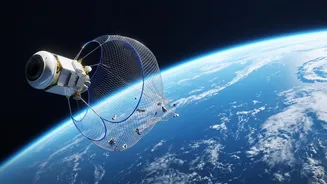
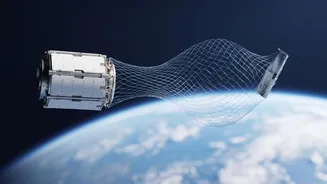
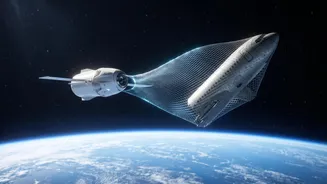
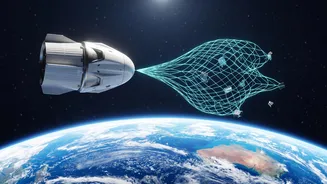
The headline's 'magnetic net' concept points to a hybrid approach. While simple nets have been tested in space—the RemoveDEBRIS mission successfully snared a target in 2018—they are primarily mechanical. However, researchers have proposed combining net systems with electromagnetic properties. An 'Electromagnetic-net' could theoretically capture a wider variety of debris, including non-magnetic objects, by using magnetic fields to assist in ensnaring or controlling them. Another related technology is the electrodynamic tether. This involves attaching a long, conductive wire to a piece of debris. As the tether moves through the Earth's magnetic field, it generates an electrical current, creating drag that gradually slows the object and causes its orbit to decay over time without using any propellant. These contactless and low-impact methods are crucial for dealing with older, uncooperative debris that wasn't designed for capture and may be tumbling uncontrollably.
The Future of a Sustainable Space
While technologies like magnetic grappling are moving from demonstration to commercial service, many advanced concepts remain in development. Researchers are exploring using spinning magnetic fields to manipulate objects without any physical contact at all, a technique that could one day be used to gently stabilize and de-orbit tumbling, non-cooperative junk. However, technology is only part of the solution. The challenge is enormous, and no single method will solve the problem entirely. The future of keeping space usable will require a combination of these innovative cleanup technologies, international cooperation, and a fundamental shift in how we design satellites. Building spacecraft with end-of-life deorbiting plans and standardized docking plates for future removal is just as important as inventing new ways to catch the garbage already out there.