





Our Invisible Reliance on Satellites
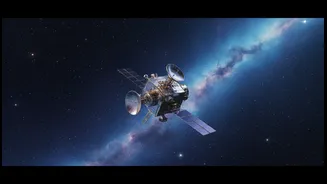
From navigating with GPS on our phones to making digital payments, watching live television, and getting accurate weather forecasts, our daily lives in India are deeply intertwined with a network of satellites orbiting silently above us. This orbital
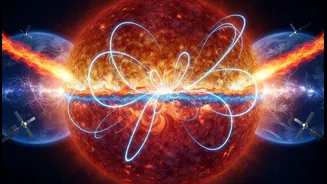
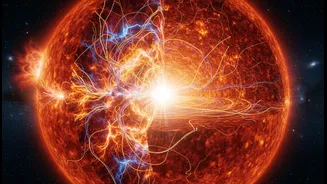
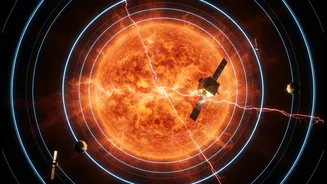
infrastructure is the backbone of modern communication, national security, and economic activity. Yet, this critical system is incredibly fragile. It faces a constant and powerful threat from our own star, the Sun. Violent solar events, like solar flares and coronal mass ejections (CMEs), can send waves of charged particles and radiation hurtling towards Earth, creating what is known as space weather. When these storms hit, they can have devastating consequences for our orbital assets.
What is The Sun's Tachocline?
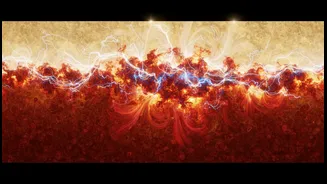
To understand how we can protect our satellites, we must journey 200,000 kilometres beneath the Sun's visible surface. The Sun's interior has distinct layers. At the center is the core, where nuclear fusion occurs. Surrounding that is the radiative zone, where energy travels as radiation. The outermost interior layer is the convection zone, a boiling sea of hot plasma. Between the calm radiative zone and the turbulent convection zone lies a thin, incredibly important boundary: the tachocline. It’s a place of immense shear, where the two zones, which rotate at different speeds, grind against each other. The radiative interior rotates like a solid ball, while the convection zone spins faster at its equator than at its poles. The tachocline is the chaotic interface where these two different rotations meet.
The Engine of Solar Storms
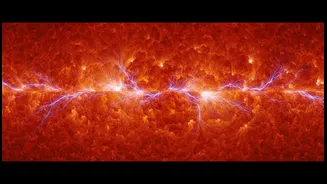
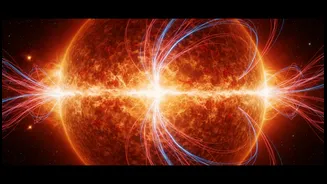
Scientists believe this turbulent shearing in the tachocline is the powerhouse of the solar dynamo—the process that generates the Sun's massive magnetic field. Think of it as a cosmic generator. The churning and stretching of plasma in the tachocline twists and amplifies magnetic field lines. Eventually, these magnetic fields become so intense that they burst through the Sun's surface, creating sunspots. These sunspots are often the origin points for solar flares and CMEs. Therefore, the chaotic activity deep within the tachocline is directly responsible for the dangerous space weather that reaches Earth. Understanding what happens in this hidden layer is the first step to predicting when the Sun might unleash a potentially damaging storm.
How This Research Protects Satellites
When a powerful solar storm strikes, it can harm satellites in several ways. The high-energy particles can fry sensitive electronics, a phenomenon known as single-event effects. The storm can also heat and expand Earth's upper atmosphere, increasing atmospheric drag on satellites in low-Earth orbit. This extra drag can cause them to lose altitude and even fall out of orbit, as happened to a batch of Starlink satellites in 2022. By studying the tachocline, scientists can create more accurate models of the solar dynamo. This allows for better forecasting of the 11-year solar cycle and improved predictions of when and where powerful solar storms might erupt. With advance warning—even just a day or two—satellite operators can take protective measures. They can power down sensitive components, reorient the spacecraft to protect vital instruments, or prepare for potential orbital adjustments, safeguarding billions of dollars worth of infrastructure.
India's Eye on the Sun: Aditya-L1
India is a key player in this global effort to understand our star. The Indian Space Research Organisation's (ISRO) Aditya-L1 mission is a dedicated solar observatory. Positioned at a unique vantage point 1.5 million kilometres from Earth, Aditya-L1 has an uninterrupted view of the Sun. Its suite of seven instruments observes the Sun's outer layers—the photosphere, chromosphere, and corona—and measures the solar wind and magnetic field. While Aditya-L1 does not directly probe the tachocline, its continuous monitoring of solar flares, CMEs, and other surface phenomena provides crucial data. This data helps scientists connect the dots between the Sun's visible activity and the deeper processes occurring within, including in the tachocline. By contributing to global space weather models, Aditya-L1 enhances India's—and the world's—ability to anticipate solar storms and protect the satellite-based services we all depend on.