



The Incredible Shrinking Star
Stars are not static objects; they are massive nuclear furnaces that are constantly converting their own mass into energy. For stars like our Sun, this process is slow and steady for billions of years. But as they approach the end of their lives, this mass loss
accelerates dramatically. They swell into enormous red giants, shedding their outer layers into space through powerful stellar winds. Eventually, all that remains is a dense, Earth-sized core called a white dwarf, which might contain only half of the star's original mass. This fundamental change has profound consequences for anything that remains in orbit.
Gravity's Loosening Grip
The relationship between a star and its planets is governed by gravity, and gravity is a direct function of mass. When a star loses mass, its gravitational pull on its orbiting planets weakens. Imagine swinging a ball on a string; if the string gets longer, the ball swings in a wider circle. In a similar way, as the central star's gravity lessens, the planet's orbit naturally expands. The planet drifts further away, settling into a new, wider, and slower orbit that is stable for the star's reduced mass. This process is a key factor in determining which planets can survive their star's violent final phases.
Evidence From a Ghostly System
This isn't just a theory. Astronomers have found compelling evidence by studying white dwarf systems—the remnants of stars that have completed their life cycle. The discovery of giant planets orbiting these dead stars confirms that planets can indeed survive the ordeal. For example, a Jupiter-sized planet candidate, WD 1856 b, orbits its white dwarf host in an extremely tight 1.4-day loop. While this planet likely migrated inwards after its star's death due to gravitational interactions with other objects, its very existence around a white dwarf is a crucial piece of the puzzle. Other discoveries show planets in wide orbits that align with the predictions of orbital expansion due to stellar mass loss.
A Glimpse of Our Solar System's Future
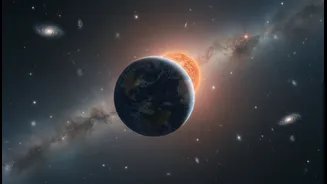
These distant systems provide a preview of our own solar system's fate. In about five billion years, our Sun will begin its transformation into a red giant. It will swell, engulfing Mercury and Venus, and its intense heat will boil Earth's oceans long before that. However, there is a cosmic tug-of-war at play. While the expanding Sun threatens to swallow Earth, its simultaneous mass loss will push our planet's orbit outward. Recent studies suggest that Earth might just escape being engulfed, settling into a new, more distant orbit around the white dwarf that the Sun will become. Mars and the gas giants like Jupiter and Saturn are expected to survive and drift into even wider orbits. Life on Earth will be long gone by then, but the planet itself may endure, a frozen rock circling a dim, stellar ghost.