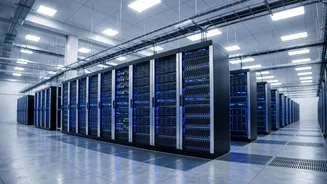







From streaming video to the rise of AI, our digital world runs on data centres. A new forecast sees India's capacity multiplying fivefold by 2030, a huge leap forward. But this growth is far from guaranteed, facing critical roadblocks.
The Scale of the Surge
India's data centre
industry is gearing up for an investment supercycle. According to a recent report from Crisil Ratings, the nation's installed capacity is projected to surge fivefold to approximately 7.5 gigawatts (GW) by March 2030. This monumental expansion is expected to attract investments exceeding Rs 3 lakh crore over the next four years alone. This growth isn't just a number; it represents a fundamental shift in India's digital backbone, preparing the country to handle an unprecedented explosion in data. The demand is so strong that existing data centres are already operating at about 90% utilisation, and nearly half of the massive upcoming capacity is already pre-booked under long-term contracts, significantly reducing investment risks.
What's Fuelling This Digital Gold Rush?
Several powerful forces are converging to drive this incredible demand. The primary engine is the rise of generative artificial intelligence (GenAI) and machine learning, which require immense computational power. Alongside AI, the continued digitalisation of enterprises, the widespread rollout of 5G technology, and a massive increase in general data consumption are creating a perfect storm for growth. Government policies promoting data localisation, which require data to be stored within India's borders, have also been a significant catalyst. This has compelled global hyperscalers—the tech giants behind cloud services—to invest heavily in building large-scale data campuses across the country, further fuelling the investment boom.
The Infrastructure Bottleneck
While the demand is clear, the path to 7.5 GW is paved with significant challenges. The headline's warning that infrastructure timelines are 'critical' is the central issue. The biggest hurdle is power. Data centres are incredibly power-hungry, operating 24/7 at high loads. Securing timely, reliable, and high-quality power connections is a major constraint that can cause significant project delays. In fact, the upcoming capacity in key hubs like Mumbai, Hyderabad, and Visakhapatnam could consume a massive portion of their cities' current peak power demand. Beyond power, developers face hurdles in acquiring suitable land in prime locations and navigating complex regulatory approvals from multiple government bodies.
The Green Power Imperative
The massive energy consumption of data centres brings sustainability into sharp focus. With global clients and investors increasingly focused on environmental goals, providing green energy is no longer a bonus but a necessity. India's ability to develop large data centre campuses powered by renewable energy is a key competitive advantage. This aligns with the sustainability commitments of global hyperscalers, making India an even more attractive destination. However, this also adds a layer of complexity. It requires not just building the data centres themselves, but also ensuring that the surrounding energy infrastructure can support a massive shift towards reliable, renewable power sources to feed these digital factories without destabilising the grid.
Who Stands to Win?
The primary beneficiaries of this boom are the data centre developers and the global hyperscalers who lease the capacity. These hyperscalers are expected to account for 75–80% of the industry's capacity by 2030. While this provides revenue certainty for developers through long–term contracts, it also introduces a risk of customer concentration. Geographically, Mumbai and Chennai have been the dominant hubs, but the next wave of growth will be concentrated in cities like Visakhapatnam and Hyderabad alongside Mumbai. For India, the ultimate win is the potential to solidify its position as a globally competitive digital hub, capable of supporting the next generation of technology and creating a robust ecosystem for innovation, job creation, and economic growth.