


Seeing the Invisible
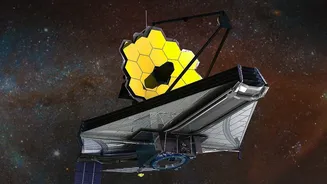
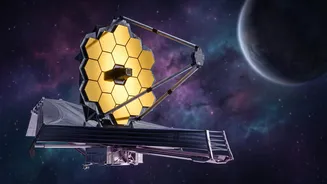
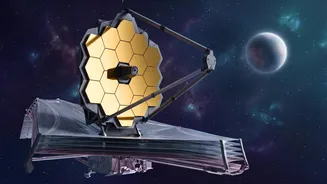
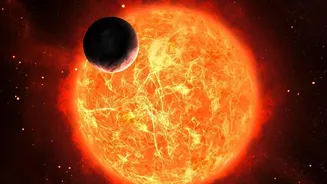
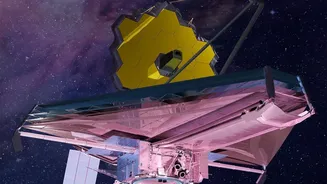
To understand if a planet dozens of light-years away could support life, scientists need to know what its atmosphere is made of. The JWST specialises in this, using a technique called transmission spectroscopy. When an exoplanet passes in front of its host
star, the star's light filters through the planet's atmosphere. Molecules in that atmosphere absorb specific wavelengths of light, leaving tiny gaps in the light that reaches the telescope. Webb's powerful infrared sensors are exquisitely tuned to detect these gaps. Because every gas—like water vapour, methane, or carbon dioxide—has a unique light-absorbing fingerprint, scientists can analyse this filtered starlight to create a chemical inventory of the planet's air.
The Search for Biosignatures
The ultimate goal is to find biosignatures: gases that are produced by living organisms. On Earth, for example, the abundance of oxygen is a direct result of photosynthesis, and much of the methane is produced by microbial life. The JWST can detect these key molecules. The presence of carbon dioxide, methane, and water vapour on a rocky planet in the 'habitable zone'—the orbital region where temperatures could allow for liquid water—would be a major step. More tantalisingly, astronomers are also looking for gases that are almost exclusively linked to life on Earth. One such molecule is dimethyl sulphide (DMS), which is primarily produced by marine phytoplankton. Finding a combination of these gases could be a powerful indicator of biological processes.
Early Clues from Distant Worlds
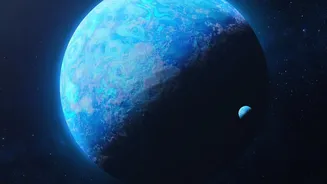
The telescope has already delivered fascinating results. One of the most studied targets is K2-18 b, an exoplanet 120 light-years away that is larger than Earth and orbits within its star's habitable zone. JWST observations have confirmed the presence of carbon-bearing molecules, including methane and carbon dioxide, in its atmosphere. This finding supports the theory that K2-18 b could be a 'Hycean' world—a planet with a hydrogen-rich atmosphere and a surface covered by a water ocean. Intriguingly, initial data also showed a possible hint of dimethyl sulphide (DMS). While this specific detection requires more validation, it represents one of the strongest hints yet of potential biological activity found on an exoplanet.
More Than Just a Chemical List
Infrared readings do more than just list ingredients; they provide context. For example, on the gas giant WASP-39 b, Webb made the first-ever detection of sulphur dioxide in an exoplanet's atmosphere. This revealed signs of active photochemistry—chemical reactions triggered by starlight—which gives scientists clues about the planet's atmospheric dynamics. In another first, Webb measured the temperature of a rocky exoplanet, TRAPPIST-1 b, by detecting the thermal energy it emits. The reading of roughly 230°C suggests it has little to no atmosphere, a crucial piece of information for determining its habitability. This ability to measure both composition and physical conditions is vital for building a complete picture of these alien worlds.
A Journey of Discovery
It's important to remember that JWST cannot see life directly. Its findings are about probability and context. Detecting a potential biosignature is not proof of life, as unknown geological or chemical processes could mimic biological ones. Scientists are careful to note that even a strong detection would require extensive follow-up observations and the elimination of all other possibilities. The telescope's data often leads to multiple interpretations and lively debate among astronomers. What is certain, however, is that Webb's infrared vision is revolutionising the field. It is moving the search for habitable worlds from the realm of theory into an era of direct observation, giving us our first real look at the chemistry of planets that could, one day, answer the question of whether we are alone in the universe.