

The Sun's death is a distant, but certain, event. For billions of years, our star has been the stable centre of our solar system, but its end will be anything but quiet. New research suggests its final act could be a chaotic, messy affair.
The Sun’s Final Act
In about five
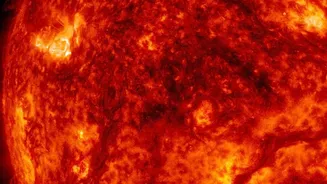
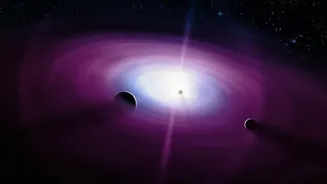
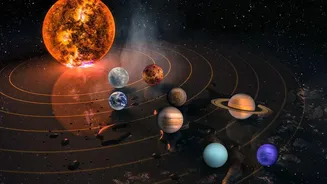
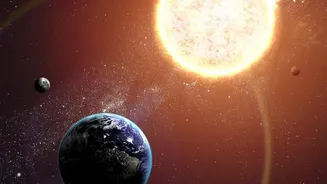
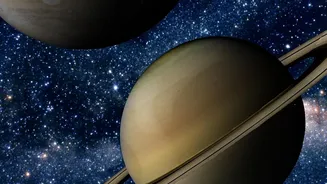
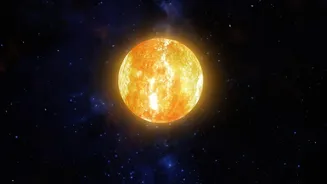
billion years, the Sun will exhaust the hydrogen fuel in its core and begin to die. This process will see it swell into a red giant, a star so enormous its outer layers will consume the inner planets, Mercury and Venus. Whether Earth will be completely engulfed or left as a scorched, lifeless rock is still debated by scientists. Previously, it was thought that after this violent expansion, the Sun would shed roughly half its mass and shrink into a dense, dim white dwarf. The surviving outer planets—Jupiter, Saturn, Uranus, and Neptune—were expected to drift into wider, but stable, orbits. This new, expanded solar system was predicted to remain intact for an almost unimaginable length of time, perhaps 100 billion years or more, until a passing star eventually knocked things askew. This picture of a relatively peaceful end, at least for the gas giants, has been the standard model for decades.
A New Wrinkle in the Story
Recent research, however, paints a much more chaotic picture of our solar system's distant future. A study published in The Astrophysical Journal Letters suggests the long-term stability once predicted for the outer planets may be a fantasy. The key difference lies in how the Sun loses mass. Earlier models assumed this process would be smooth and symmetrical, with gas being shed evenly in all directions. The new research, led by a team from the California Institute of Technology, challenges this assumption. Observations of other white dwarfs suggest that as they die, stars lose mass unevenly, in discrete, random bursts. This creates a series of 'kicks' that cause the star to recoil slightly with each ejection, fundamentally changing the gravitational dynamics of the system.
The Sun's Staggering Walk
Instead of a gentle, predictable process, the Sun’s death will be more like a staggering walk. As it sheds its outer layers in thousands of individual, asymmetric bursts, the Sun itself will be nudged in random directions. Each individual kick is small, but their cumulative effect over thousands of years is significant. For the planets still orbiting it, the gravitational centre of their universe will effectively be performing a random walk. This constant, unpredictable jostling perturbs the planetary orbits, slowly altering their shape, tilt, and the spacing between them. Previous calculations, which relied on smooth mass loss, found that the outer solar system's architecture would hold for 30 to 100 billion years. The new simulations, incorporating these stochastic kicks, shorten that timeline dramatically. The chaos could begin not long after the Sun becomes a white dwarf, and in some cases, even before.
A Nudge for the Giants
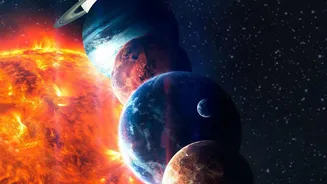
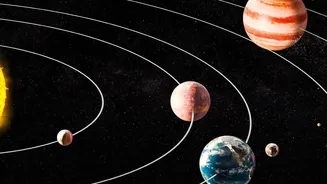
The consequences of this uneven mass loss are profound. The simulations show that the grand, stable orbits of the giant planets could quickly unravel. In about 40% of the simulations, major disruptions and violent scattering events began even while the Sun was still in its red giant phase. Within three billion years of the Sun becoming a white dwarf, roughly 90% of the simulated solar systems became unstable. This instability could lead to planets crossing paths, resulting in catastrophic collisions or ejections from the solar system entirely. Some simulations saw Saturn thrown out of the solar system, while Uranus and Neptune swapped their orbital positions. Rather than a quiet retirement, the outer solar system is now expected to face a period of violent rearrangement, collapsing its expected lifespan from a quintillion years down to a 'mere' billion.