



A Breakthrough in Cosmic Communication
For decades, space missions have relied on radio waves to send information back to Earth. While reliable, this method is like using a dial-up modem in an age of fibre optics. The amount of data modern scientific instruments can collect far exceeds the
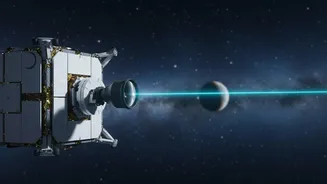
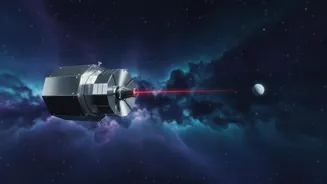
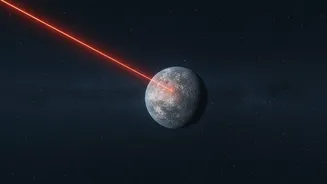
capacity of radio frequencies to transmit it efficiently. Now, a groundbreaking technology demonstration by NASA, known as Deep Space Optical Communications (DSOC), is changing the game. This system uses lasers to transmit data at rates 10 to 100 times greater than the most advanced radio systems currently in use. The technology successfully streamed a 15-second, ultra-high-definition video from the Psyche spacecraft when it was 31 million kilometres from Earth. The video, featuring a cat named Taters, arrived in just 101 seconds, transmitted at a remarkable 267 megabits per second (Mbps) — a speed comparable to terrestrial broadband internet.
Radio Waves vs. Laser Beams
The fundamental difference between radio and laser communications lies in the frequency of the electromagnetic waves used. Lasers use near-infrared light, which has a much higher frequency than radio waves. This higher frequency allows more data to be packed into the signal, enabling significantly higher data rates. Think of it as the difference between a narrow country lane and a multi-lane superhighway. Radio waves spread out as they travel, a phenomenon known as beam divergence, which weakens the signal over vast distances. Laser beams are far more focused, which means more of the signal reaches its target. This not only boosts speed but also enhances security, as the narrow beam is much harder to intercept or jam. Furthermore, the equipment required for laser communications is typically smaller, lighter, and requires less power than comparable radio systems — all critical advantages when designing spacecraft where every gram and watt counts.
The Psyche Mission's Historic Test
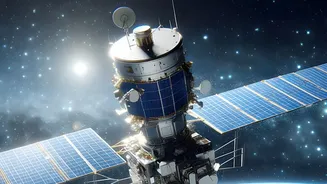
The DSOC system is a technology demonstration hitching a ride on NASA’s Psyche spacecraft, which launched in October 2023 on a mission to study a unique metal-rich asteroid. While Psyche itself uses traditional radio communications for its primary mission data, the DSOC experiment has been testing the limits of laser technology during the spacecraft's journey. In a landmark test, the system beamed the now-famous cat video to the Hale Telescope at Caltech's Palomar Observatory. The experiment has continued to set records as the spacecraft travels farther away. Even at a distance of 226 million kilometres, it transmitted data at 25 Mbps. This proves that the technology is viable not just for near-Earth applications but for deep space exploration, paving the way for missions to Mars and beyond.
What This Means for the Future
The success of DSOC is more than just a technical achievement; it unlocks a future where deep space exploration is more data-rich and immediate than ever before. For future human missions to Mars, this technology could enable high-definition video calls with astronauts, real-time monitoring of life support systems, and the swift transmission of vast amounts of scientific data. Robotic missions will also benefit immensely. Instead of waiting weeks to download a complete high-resolution map of a planetary surface, it could be done in days. This acceleration allows scientists to analyse data faster and make more timely decisions for their missions. It effectively creates an interplanetary internet, laying the groundwork for a sustained human and robotic presence throughout the solar system. This increased bandwidth is essential for achieving our future exploration and science goals, transforming how we communicate during interplanetary missions.