



Worlds of Fire and Wind
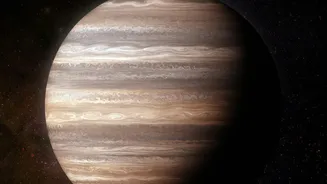
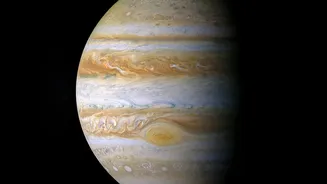
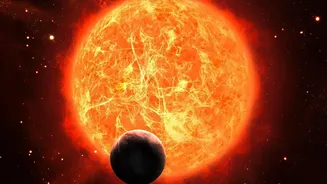
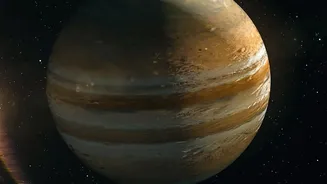
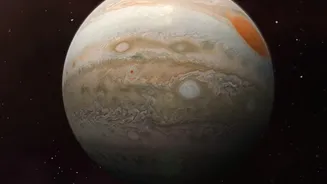
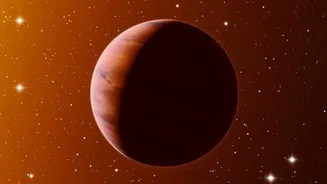
Imagine a planet larger than Jupiter, orbiting so close to its star that its surface temperature can melt iron. These are the 'hot Jupiters', a class of giant gas exoplanets that are unlike anything in our own cosmic neighbourhood. Because they are tidally
locked, one side perpetually faces the blistering heat of their star, while the other is locked in a permanent, cooler night. This extreme temperature difference between the day and night sides is the engine for some of the most violent weather in the known universe. The scorching heat from the star-facing side causes the atmosphere to expand and rush toward the cooler night side, creating ferocious, planet-circling winds. These are not just strong gales; on many of these worlds, the winds reach supersonic speeds, moving faster than the speed of sound through the planet's own atmosphere.
How to Clock a Storm Light-Years Away
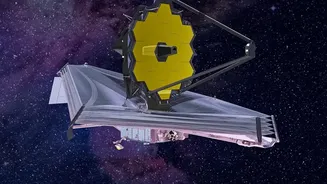
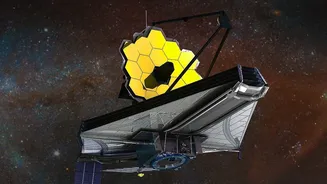
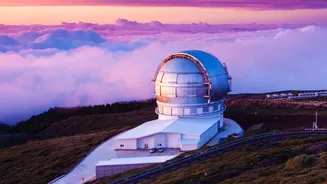
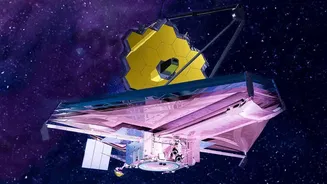
Measuring wind speed on a planet you can't even see as a distinct disk sounds like science fiction, but astronomers achieve it through a clever technique called transit spectroscopy. When an exoplanet passes in front of its host star from our perspective, a tiny amount of starlight filters through the planet's atmosphere. Telescopes, particularly powerful infrared instruments like the James Webb Space Telescope (JWST) and ground-based observatories like the Very Large Telescope (VLT), can analyse this light. Molecules in the atmosphere, like water vapour or carbon monoxide, absorb specific wavelengths of light, leaving a chemical fingerprint. By studying the Doppler effect on these fingerprints—how the light is stretched or compressed—scientists can tell how fast the atmosphere is moving. If one side of the planet's atmosphere is moving towards us and the other away, it creates a distinct double-peaked signal, allowing astronomers to calculate the speed of the equatorial jet stream.
Faster Than a Speeding Bullet
The speeds being recorded are staggering. On an exoplanet named WASP-127b, located over 500 light-years away, astronomers have measured an equatorial jet stream tearing around the planet at up to 33,000 kilometres per hour. To put that in perspective, the fastest winds ever recorded in our own solar system are on Neptune, and they top out at around 2,000 km/h. This makes the winds on WASP-127b more than 15 times faster. On another world, HAT-P-70 b, winds blow from the scorching day side to the cooler night side at speeds of up to 18,000 km/h. These discoveries show that the weather on these distant worlds operates on a scale that is difficult to comprehend, driven by physical processes far more extreme than anything we experience on Earth. The planets are so hot that minerals can vaporise, form clouds, and then rain down as liquid gems or metals in cooler parts of the atmosphere.
Why Study Cosmic Weather?
Studying these extreme atmospheric dynamics is more than just cosmic sightseeing. It provides a crucial laboratory for understanding how planetary atmospheres work under conditions not found in our solar system. By observing how heat is distributed from a planet's hot side to its cold side, scientists can refine their models of atmospheric circulation, which helps in understanding planet formation and evolution. Furthermore, this research is a key step toward understanding which planets might be able to hold onto their atmospheres over billions of years. Some studies suggest that the interaction of these winds with a planet's magnetic field could be detected, offering the first clues about the magnetic fields of worlds beyond our own. Since a magnetic field is considered essential for protecting a planet from harmful stellar radiation, this research indirectly aids the ongoing search for habitable environments in the galaxy.