




Echoes of a Lost Port
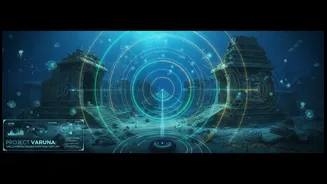
Ancient Tamil Sangam literature speaks of a magnificent port city called Poompuhar, or Kaveripoompattinam, the glorious capital of the early Chola kings. Described in texts like 'Silappathikaram' and 'Manimekalai', it was a thriving hub of international
trade, where ships from Rome and Southeast Asia docked. Legend, however, tells a somber tale: the city enraged a sea goddess and was consumed by the ocean, vanishing from sight but not from memory. For generations, this story was passed down, a blend of myth and history. But recent scientific expeditions suggest these accounts are rooted in a dramatic reality.
The High-Tech Marine Detective
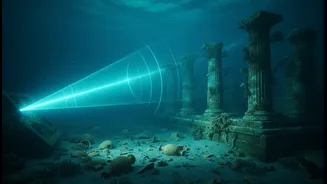
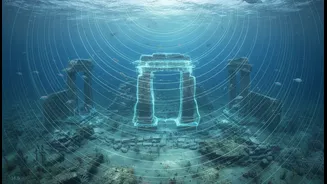
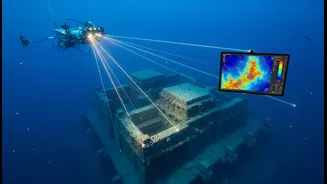
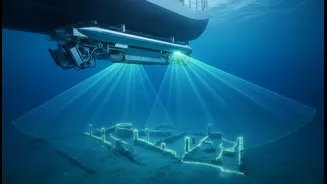
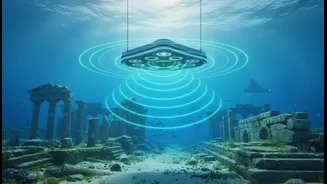
The key to unlocking this underwater mystery is advanced sonar technology. Scientists from the National Institute of Ocean Technology (NIOT) and other institutions are using multibeam echosounders to map the seabed in incredible detail. Imagine a device on a ship sending out a wide fan of sound waves. These waves travel to the ocean floor, bounce back, and are recorded. By measuring the time it takes for these 'echoes' to return, scientists can create a high-resolution, three-dimensional map of the seabed, revealing shapes and structures hidden beneath meters of water and sediment. This is far more advanced than older methods and can survey vast areas, essentially allowing archaeologists to 'see' what lies below without disturbing it.
What the Sonar Scans Revealed
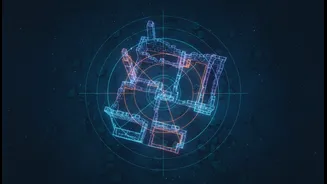
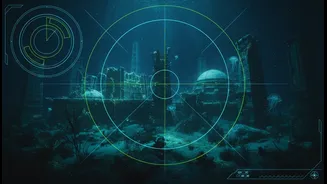
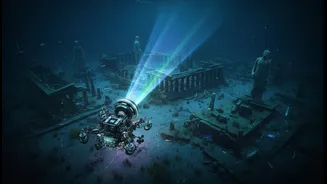
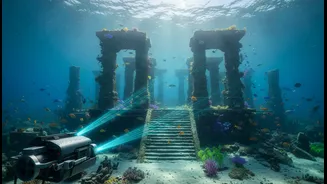
The data collected off the Poompuhar coast has been astonishing. The sonar scans have revealed features that are difficult to explain as natural formations. Researchers have identified what appear to be man-made, grid-like structures, walls, and building foundations. In a major discovery, studies have pointed to a massive harbour-like structure, potentially spanning several kilometres, with features resembling breakwaters and canals for guiding ships. Some scans even suggest the remains of a lighthouse. These structures were found at depths of up to 100 metres and located as far as 40 kilometres from the current coastline, hinting at a city far larger and older than previously imagined.
Connecting Science with Ancient Stories
These findings are a powerful bridge between ancient literature and modern science. The structures identified by sonar align remarkably with the literary descriptions of Poompuhar as a well-planned city with a significant port. While early explorations found brick structures and ring wells from the Sangam period, the newer, deeper discoveries suggest a much longer history. Some research, based on past sea-level data correlated with the submerged landforms, speculates that the area could have been inhabited as far back as 15,000 years ago, shifting over millennia as the sea rose. This challenges the conventional timeline and suggests the legend of the city being 'swallowed by the sea' may describe a long-term process of submergence.
The Next Wave of Discovery
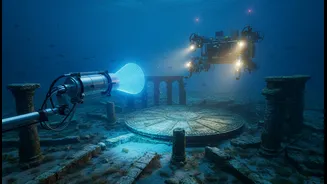
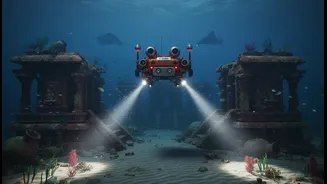
Mapping the area with sonar is just the first step. The next phase of this exciting project involves verifying the data with physical exploration. The Department of Science and Technology is leading a major initiative to digitally reconstruct the city. This involves using Remotely Operated Vehicles (ROVs) to get clear images and videos of the structures detected by sonar. Scientists also plan to collect sediment core samples from the seabed. These samples can be dated and analysed for evidence of human activity, helping to confirm the age of the site and what it was used for. This ongoing work, combining multiple scientific disciplines, promises to transform our understanding of India's ancient maritime past.