



An Illusion as Old as Stargazing
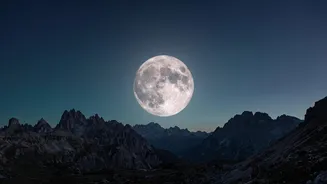
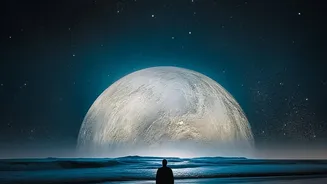
First, let's get one thing straight: the Moon itself doesn't change size. If you were to take a photo of the horizon moon and the zenith moon (the one high overhead), they would be virtually identical in diameter. In fact, due to the geometry of your
position on Earth, the moon on the horizon is technically a tiny bit farther away from you than when it's directly overhead, so it should appear slightly smaller, not larger. The fact that it looks bigger is a powerful and persistent optical illusion, one that has puzzled thinkers from Aristotle to modern neuroscientists. The phenomenon is known as the Moon Illusion, and it's a fascinating window into how your brain actively constructs your perception of reality.
The Brain's Faulty 'Apparent Distance' Logic
One of the leading theories behind this illusion is the 'apparent distance' hypothesis. Your brain has learned that the sky isn't a perfect dome; it appears as a flattened bowl. Because of clouds, haze, and our experience with terrestrial landscapes, we perceive the sky at the horizon as being much farther away than the sky directly above us. When the Moon appears at this seemingly more distant horizon, our brain applies a rule of thumb known as size constancy. It reasons that for an object to have the same angular size (the space it takes up in our field of view) but be much farther away, it must be physically enormous. So, your brain 'helpfully' inflates the Moon's perceived size to make it fit this flawed assumption.
The Power of Comparison
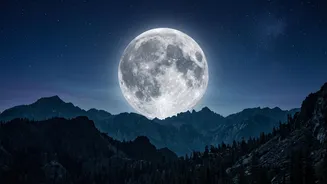
The headline's mention of 'relative size judgments' points to another key factor, famously illustrated by the Ponzo and Ebbinghaus illusions. The Ponzo illusion shows that two identical lines can appear to be different lengths when placed between converging lines, like railroad tracks. Your brain interprets the converging lines as a cue for distance, making the 'farther' line seem larger. The Moon illusion works similarly. When the Moon is on the horizon, it's surrounded by familiar objects with a known size—trees, buildings, mountains. Next to these relatively small items on the landscape, the Moon looks gigantic. But when it's high in the sky, it's surrounded only by the vast, empty expanse of space. With no objects for comparison, your brain perceives it as a smaller, more isolated object.
It's a Team Effort of Deception
Like many complex brain phenomena, the Moon illusion probably isn't caused by a single factor. Instead, it’s likely a combination of the apparent distance hypothesis and the relative size effect working together. Our brains are constantly using context and environmental cues to build a 3D model of the world around us. In this case, the cues from the terrestrial landscape send a strong signal: 'things on the horizon are far away and should be scaled up for proper viewing'. The empty sky, meanwhile, offers no such cues. The result is a powerful and convincing illusion where your brain's sophisticated processing power actually leads you to the wrong conclusion. It’s a perfect reminder that seeing isn't just a passive act of recording light; it’s an active process of interpretation.