


The Ultimate Insurance Policy
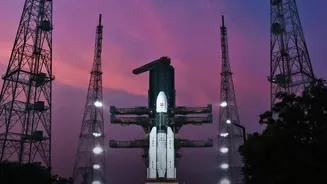
Human spaceflight is inherently risky, especially during the violent initial ascent. The Gaganyaan mission, which aims to launch a crew of three into a 400 km orbit, relies on the Human Rated LVM3 (HLVM3) rocket. While powerful, rockets are complex machines
where anomalies can occur. To counter this, the Indian Space Research Organisation (ISRO) has engineered a critical safety feature: the Crew Escape System (CES). This system is not just a component; it is an astronaut's ultimate insurance policy, designed to function flawlessly in the critical moments when a mission goes wrong. Its sole purpose is to pull the crew module and its occupants away from a failing rocket, ensuring their survival.
How the Crew Escape System Works
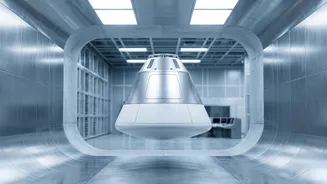
The CES is a rocket-powered mechanism mounted at the very top of the launch vehicle, directly above the crew module. It is essentially a small, powerful rocket designed to do one job: get the crew away, fast. The system is armed with a cluster of quick-acting solid-propellant motors that can generate immense thrust almost instantly. Continuous health monitoring sensors across the launch vehicle can detect any dangerous deviation—such as a loss of thrust, a sudden change in direction, or a structural failure—within milliseconds. If an anomaly is detected, the onboard computers trigger the abort sequence automatically. Pyrotechnic bolts fire to sever the crew module from the main rocket, and the CES motors ignite, pulling the capsule upwards and away from the danger zone with an acceleration that can be many times that of gravity.
Scenario 1: Abort from the Launchpad
One of the most dangerous moments is right on the launchpad, before or during ignition. If a catastrophic failure is imminent, the CES must act with zero hesitation. This scenario was tested during the Pad Abort Test (PAT). In this test, conducted in July 2018, a 12.6-tonne simulated crew module was propelled skyward from the launchpad at Sriharikota. The escape motors fired for a few seconds, lifting the module to an altitude of nearly 2.7 km and pushing it out over the Bay of Bengal, where it then deployed its parachutes for a safe splashdown. This successful test proved the system could safely recover the crew even from a standstill.
Scenario 2: In-Flight Abort During Ascent
An abort during the rocket's climb through the atmosphere presents a different challenge. The vehicle is travelling at high speed, experiencing immense aerodynamic pressure. The CES must not only pull the crew module away but also ensure it maintains a stable trajectory. ISRO demonstrated this capability with the Test Vehicle Demonstration Mission-1 (TV-D1) in October 2023. A test vehicle carried a crew module to an altitude of about 17 km, travelling at 1.2 times the speed of sound. At this point, an abort was deliberately triggered. The escape motors fired, separating the module from the booster. The system worked perfectly, with the crew module later deploying its parachutes and splashing down safely for recovery by the Indian Navy.
From Separation to Splashdown
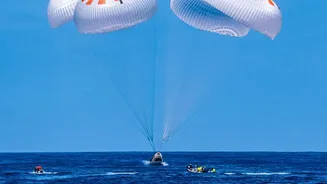
The escape sequence is a precisely choreographed series of events. After the escape motors fire and pull the crew module to a safe distance, the CES tower itself is jettisoned. The module then reorients itself for descent. A series of parachutes deploy in stages. First, smaller drogue parachutes open to stabilize and slow the fast-moving capsule. Following this, the three large main parachutes deploy to slow the module to a gentle speed for a soft splashdown in the ocean. This entire sequence, from abort trigger to parachute deployment, is automated to ensure the fastest possible response.
Why Rigorous Testing is Non-Negotiable
These abort tests are not mere rehearsals; they are full-scale validations of the systems that will protect human lives. Each test, from the Pad Abort to the high-altitude TV-D1 mission, gathers hundreds of points of data from sensors that monitor every aspect of performance. These tests are performed in a series to check the system's performance across the entire flight envelope—from the ground all the way to the upper atmosphere where the CES is no longer needed. Recent updates from September 2026 confirm that preparations for further tests, like the TV-D2 mission, are in advanced stages, demonstrating ISRO's methodical and safety-first approach.