






A Planet Found, Then Lost
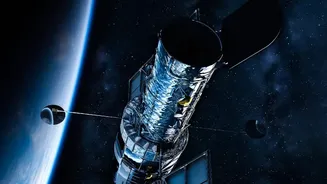
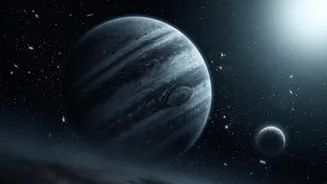
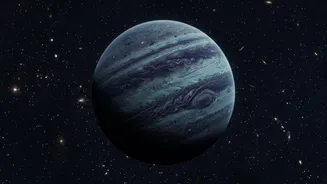
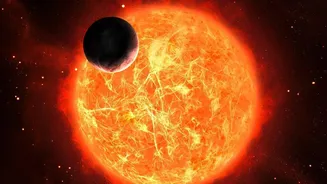
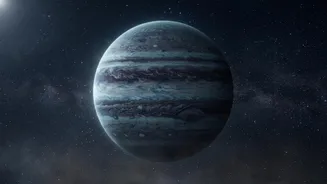
About 1,000 light-years from Earth, a gas giant known as TOI-2535 b was first spotted in 2019 by NASA’s Transiting Exoplanet Survey Satellite (TESS). This type of planet is called a 'hot Jupiter' because it's a massive gas world, similar to our own Jupiter,
but orbits incredibly close to its star. TESS finds planets by watching for tiny, regular dips in a star's brightness, which happen when a planet passes in front of it—an event called a transit. For seven years, TESS watched TOI-2535 b complete its speedy 8.25-day orbit. But then, in March 2026, the signal stopped. The planet, it seemed, had vanished.
The Cosmic Disappearing Act
Planets don't just disappear. So, what caused the transits of TOI-2535 b to cease? Even before it vanished, astronomers noticed oddities. The planet’s transits weren't perfectly timed; they would sometimes happen up to six hours early or late. The dips in starlight also became shorter and shallower over the years, as if the planet was only just grazing the edge of its star before it disappeared completely. This wasn't a case of a faulty telescope. The data was clear: the planet's path in the sky was changing rapidly, a baffling astronomical event happening on a human timescale.
The Hidden Culprit
The leading theory is that TOI-2535 b is not alone. Scientists believe a second, unseen planet is locked in a gravitational dance with it. This hidden companion, likely a massive planet itself, has a tilted orbit relative to TOI-2535 b. Their mutual gravitational pulls are causing the orbits of both planets to wobble like spinning tops. This wobble, known as orbital precession, is slowly changing the angle of TOI-2535 b's orbit as seen from Earth. The planet didn't disintegrate or fly off into space; its orbit simply tilted out of our line of sight. For a transit to be visible, the alignment between Earth, the star, and the planet must be precise. That perfect alignment is now gone.
Why This Is a Big Deal
This is the first time astronomers have directly observed a planet's transits disappearing because of this kind of orbital tilting around a single star. It provides a living laboratory for understanding planetary dynamics. While we often think of solar systems as stable, clockwork mechanisms, TOI-2535 b shows how interactive and chaotic they can be. This discovery also offers clues about how hot Jupiters form. These planets are thought to form far from their stars and migrate inward. The presence of a close, massive companion in the TOI-2535 system suggests it likely migrated through a slow, spiraling process rather than a violent cosmic collision.
Will We See It Again?
The good news for planet hunters is that this disappearance is likely temporary. Based on their models, scientists predict that the orbital wobble will eventually bring TOI-2535 b back into a transiting alignment with Earth. However, patience is required. This cosmic game of peek-a-boo might not have its next reveal for another 30 to 50 years. In the meantime, astronomers are excited by the possibility that the unseen companion planet, TOI-2535 c, might wobble into our line of sight much sooner. The disappearing act of one planet may have been the key to discovering another.