



From Proteins to the Genetic Playbook
Just a few years ago, Google DeepMind's AlphaFold revolutionised biology by predicting the 3D structure of almost every known protein, solving a 50-year-old grand challenge. This was like getting a list of all the parts in an engine. Now, with the AlphaGenome
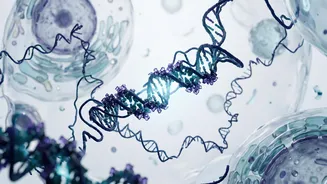
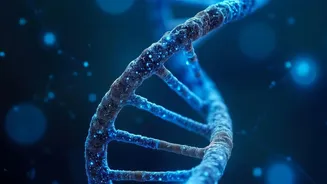
2 initiative, DeepMind is taking the next logical step: trying to figure out the instruction manual. It’s not just about what the parts are, but when, where, and how they are used. Every cell in your body has the same DNA, but a heart cell and a brain cell behave very differently because they use different genes at different times. This process, known as gene expression, is controlled by the vast, mysterious 98% of our DNA that doesn't directly code for proteins. For decades, this 'non-coding' DNA was dismissed as 'junk', but scientists now know it's the critical regulatory playbook that governs our biology.
Decoding the 'Dark Matter' of DNA
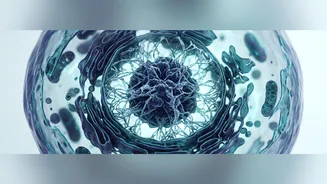
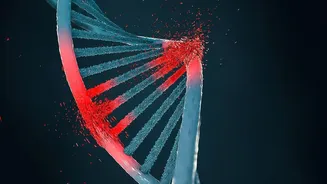
Understanding this genetic 'dark matter' has been incredibly difficult. The instructions are complex, and a single variant, or 'typo', in this non-coding DNA can have profound effects on health, contributing to diseases like cancer and heart conditions. This is where AlphaGenome 2 comes in. It’s an AI model designed specifically to look at a long sequence of DNA—up to a million letters at a time—and predict how it behaves. Building on its predecessor, which looked at tissues broadly, AlphaGenome 2 can predict how a DNA sequence functions in specific, individual cell types. By training on data from millions of individual cells, the AI learns to predict how variants in DNA impact gene activity, physical DNA packaging, and other chemical switches that control cellular function.
How the AI Predicts Gene Activity
At its core, AlphaGenome 2 works by pattern recognition on a massive scale. It was trained on vast public datasets of genomic information, learning the complex relationships between DNA sequences and their functional outputs, like gene expression levels. The model takes a raw DNA sequence and a specific cell type as inputs. It then predicts thousands of molecular properties, including where genes are turned on or off and how accessible the DNA is. By comparing the prediction for a 'normal' DNA sequence to one with a genetic variant, scientists can get a score that estimates how likely that variant is to cause a problem. In early benchmarks, AlphaGenome 2 has proven significantly more accurate than previous models, identifying nearly twice as many gene-altering variants.
The Real-World Impact on Medicine
This isn't just an academic exercise. The ability to accurately predict the impact of genetic variants could revolutionise medicine. For patients on a 'diagnostic odyssey' with rare genetic diseases, AI tools like this could dramatically shorten the search for a cause by pinpointing the exact mutation responsible. For drug developers, AlphaGenome 2 can help identify the most promising targets for new therapies and guide the design of gene and cell-based treatments. By previewing the effects of thousands of mutations at once, the AI allows researchers to prioritise which experiments to run in the lab, saving immense time and resources and accelerating the path to new discoveries. It's a key step toward a future of truly personalised medicine, where treatments can be tailored to an individual’s unique genetic makeup.
Challenges and the Road Ahead
Despite the excitement, AlphaGenome 2 is a research tool, not a clinical diagnostic system on its own. Its predictions are incredibly powerful hypotheses, but they must be validated with physical lab experiments before they can be used to make decisions about patient care. As with any powerful AI, human experts remain essential for interpreting the results and understanding the clinical context. Furthermore, ensuring these AI tools are validated across diverse populations is critical to avoid entrenching biases in a new generation of medical technology. The launch of AlphaGenome 2 isn't the end of the story, but rather the opening of a new chapter where AI and biology work together to unravel the deepest complexities of life.