




The Ultimate Ghost Particle
A neutrino is a subatomic particle with almost no mass and no electric charge. This makes it incredibly difficult to detect, as it rarely interacts with other matter. Billions of them from the Sun pass through your thumbnail every second, yet you feel
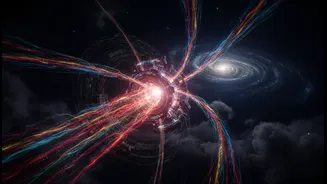
nothing. While we can create low-energy neutrinos in nuclear reactors, the source of the most powerful, high-energy neutrinos from deep space has been a long-standing puzzle for physicists. These particles travel for billions of light-years in straight lines, carrying pristine information about their violent cosmic birthplaces. Finding their origin means unlocking secrets about the most extreme events in the universe.
Prime Suspects: Monster Black Holes
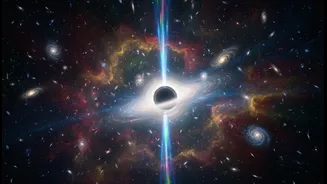
Until recently, the leading theory pointed to Active Galactic Nuclei (AGNs). These are the hyper-luminous cores of distant galaxies, powered by supermassive black holes devouring surrounding gas and dust. In 2022, a breakthrough occurred when the IceCube Neutrino Observatory in Antarctica gathered compelling evidence that a nearby active galaxy, NGC 1068, was a steady source of high-energy neutrinos. This discovery was hailed as a major step forward, confirming that these cosmic engines are indeed powerful particle accelerators. For a time, it seemed the case of the missing neutrino source was finally being solved, with monster black holes as the primary culprits.
A New Challenger Appears
However, a recent analysis has introduced an unexpected new candidate. According to findings released in June 2026, a distant galaxy nicknamed the "Shadow Blaster" appears to be a source of high-energy neutrinos. What makes this significant is that the power source doesn't appear to be a supermassive black hole. Instead, researchers believe the neutrinos are being generated by an extreme burst of star formation. This process, where countless massive stars are born and die in a short period, could be powerful enough to create the conditions needed for high-energy particle acceleration. While this interpretation is still new and not yet the consensus view, it challenges the black-hole-centric model and suggests there may be more than one way for the universe to cook up these ghost particles.
The Multi-Messenger Revolution
This kind of discovery is only possible thanks to the dawn of multi-messenger astronomy. This new field combines observations from different cosmic 'messengers' — not just light, but also gravitational waves, cosmic rays, and, of course, neutrinos — to get a complete picture of an event. When a high-energy neutrino is detected by an observatory like IceCube, alerts are sent to telescopes worldwide to search the same patch of sky for light (like gamma rays or X-rays). If a correlation is found, scientists can be much more confident they’ve found the source. It’s like hearing a thunderclap (the neutrino) and then seeing the lightning flash (the light) to pinpoint the storm.
A Deeper Look at Galaxy Evolution
Pinpointing the sources of these particles isn't just about bagging exotic cosmic trophies. It's fundamental to our understanding of the universe. High-energy neutrinos are produced alongside cosmic rays—charged particles that are constantly bombarding Earth. Because cosmic rays are charged, their paths are bent by magnetic fields, scrambling their origins. Neutrinos, being neutral, point directly back to their source. By finding neutrino factories, we also find the accelerators of cosmic rays. Understanding where and how this energy is generated and distributed throughout the cosmos provides crucial input for our models of how galaxies form, grow, and interact over billions of years.