




An Old, Oversimplified View
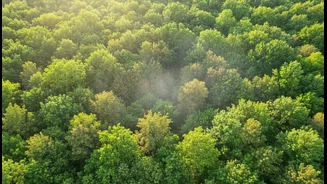
For years, many scientific models used to predict how forests will fare in a changing climate have treated them as vast, uniform green carpets. These models often simplified the complex reality of a forest, assuming that most trees within a given area
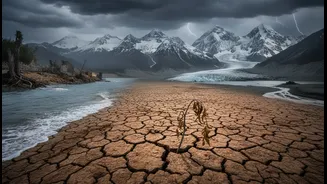
would respond similarly to environmental stresses like drought. This approach was practical, but it glossed over a fundamental truth: a forest is a diverse community of individuals. The long-held assumption was often that the tallest trees were the most vulnerable during a drought. The logic seemed simple: pumping water hundreds of feet into the air against gravity is an enormous physical challenge, and any water scarcity would logically hit these giants the hardest. This assumption was embedded in some climate-change impact models, influencing how we predict everything from forest die-offs to global carbon cycles.
A Tale of Two Trees
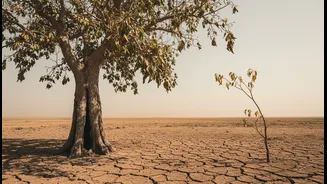
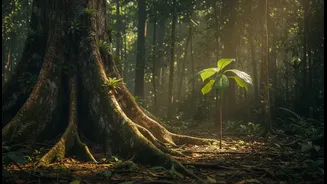
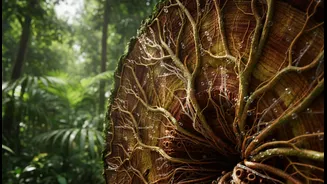
Recent research has powerfully challenged this traditional view. While some studies have found that large trees die at higher rates during extreme droughts, others reveal a more nuanced story. It turns out that tall and small trees face different kinds of threats. For the tallest trees, the primary challenge is hydraulic. They must pull water from the ground all the way to their highest leaves, a journey that can be over 70 metres. During a drought, this creates immense tension in their water-carrying vessels (xylem), risking a catastrophic failure akin to an embolism. However, new studies have shown that many giant tropical trees have evolved sophisticated adaptations to cope. Some species develop wider water-carrying vessels near their base or have leaves that can better withstand dry conditions. In contrast, smaller, younger trees in the understory face a different battle. They compete for limited soil moisture in the top layers of earth, which can dry out quickly, and may also be vying for sunlight and nutrients with their larger neighbours.
The Opportunity: Smarter Risk Models
This is where the main opportunity lies. Recognizing that drought risk isn't one-size-fits-all allows for the creation of far more accurate and effective forest-risk models. By incorporating data on tree size, structure, and species-specific traits, scientists can move beyond broad-stroke predictions. These new, more granular models can forecast which parts of a forest are most vulnerable and, crucially, why. For instance, a model could predict that a short, intense drought might disproportionately affect smaller trees, while a prolonged, multi-year drought could begin to threaten the adapted but ultimately strained taller trees. This level of detail is a game-changer for conservation and forest management. It allows authorities to prioritize resources, identify resilient tree species for reforestation projects, and develop targeted interventions to protect the most at-risk populations within a forest.
Why This Matters for India
For India, with its vast and varied forest landscapes from the Western Ghats to the Himalayas, this scientific shift is profoundly important. India's forests are under increasing pressure from concurrent heatwaves and droughts. Studies have already shown that different forest types in the country have different levels of vulnerability. For example, the seasonal dry tropical forests in the Deccan Peninsula are considered highly vulnerable to climatic shifts. Applying these new, size-differentiated risk models could provide a much clearer picture of the threats facing India's unique ecosystems. Understanding how the magnificent Dipterocarps of the Western Ghats or the Sal forests of Central India will respond to varying drought conditions is essential for preserving biodiversity and the livelihoods of communities that depend on them. It enables more effective planning, helping ensure that India's forests, which are crucial carbon sinks, can be managed for maximum resilience.