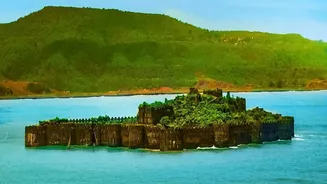






Rising from the Arabian Sea off the Konkan coast, Murud-Janjira is more than a fort; it’s a legend carved in stone. For centuries, this island fortress remained unconquered, a testament to its ingenious design and the resilience of its rulers.
An Unconquered Citadel of the Sea
Just off
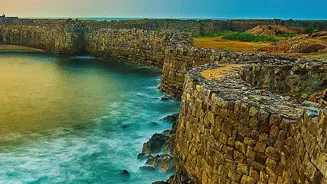
the coast of Murud in Maharashtra, the Janjira fort stands as one of India’s most formidable maritime bastions. Its name, derived from the Arabic word ‘Jazeera’ for island, perfectly describes its setting. What makes Janjira’s story so compelling is its unique distinction: it was never conquered in battle. Despite repeated sieges by the Marathas under Chhatrapati Shivaji and his son Sambhaji, as well as attempts by the Portuguese and the British, the fort’s defenses never fell. Its 40-foot-high walls, 19 imposing bastions, and strategic location made it an impregnable stronghold that dominated the sea lanes for centuries. This legacy of invincibility continued until it was politically integrated into the Indian Union in 1948, ending its sovereign status without a single military defeat.
The Legacy of the Siddi Rulers
The history of Janjira is inextricably linked to the Siddis, a community of African descent who rose from being mercenaries to powerful naval commanders and rulers. Originally serving the Nizam Shahi Sultanate of Ahmadnagar, the Siddis gained control of the island in the 15th century. The initial wooden structure, built by local fishermen to fend off pirates, was transformed into a formidable stone fortress around 1567-1571 under Siddi command. This makes the fort's stone phase approximately 450 years old. The Siddis established a ruling dynasty that controlled the fort and a small princely state from this island capital. Their naval prowess was so respected that they later served as admirals for the Mughal fleet, using the fort as a base to exert influence along the Konkan coast.
An Engineering Marvel in Stone
The architectural genius of Murud-Janjira is evident the moment you approach it by boat from the Rajapuri jetty. The main entrance is cleverly concealed, only becoming visible at close range, a design intended to confuse attacking fleets. Inside its sprawling 22ndnd acre expanse, the fort was a self-sufficient township. It contained palaces for the nobility, quarters for officers, a mosque, and, remarkably, two large freshwater lakes, ensuring a sustainable water supply despite being surrounded by the salty sea. The fort once bristled with over 500 cannons. Today, several remain, including three massive cannons named Kalal Bangdi, Chavri, and Landa Kasam, which were feared for their immense range and destructive power. The Kalal Bangdi, weighing over 22 tonnes, is considered the third-largest cannon in India.
Echoes of Famous Sieges
The fort’s reputation was forged in the fires of numerous sieges. Chhatrapati Shivaji Maharaj, the founder of the Maratha Empire, saw Janjira as a critical threat to his vision of Swarajya, which required control over the seas. He made several attempts to capture the fort between 1661 and 1670, but its defenses held firm. His son, Sambhaji Maharaj, was equally determined, even attempting to build an underwater tunnel to breach the fortress walls in 1682, an ambitious effort that was ultimately thwarted. To counter Janjira's dominance, Sambhaji also constructed the nearby Padmadurg fort, but Janjira's strategic superiority remained unchallenged. The Siddis' ability to maintain supply lines and their powerful navy made any prolonged siege incredibly difficult, cementing Janjira's unconquerable status.
A Journey to the Island Today
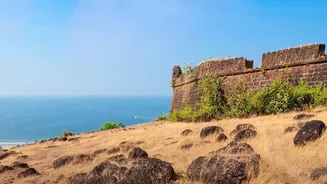
Today, a visit to Murud-Janjira is a journey back in time. The short sailboat ride from Rajapuri jetty offers a stunning view of the fort rising from the water, much as it would have appeared to traders and invaders centuries ago. Once inside, visitors can explore the labyrinthine passages, crumbling palace walls, and weathered bastions that echo with stories of its past. While many of the internal structures are now in ruins, the massive outer walls and key fortifications remain largely intact, a testament to their robust construction. Walking along the ramparts, you can still see the old cannons pointing out to sea, silent witnesses to a history of resilience. The panoramic views of the Arabian Sea from the top are breathtaking, offering a moment of peace amid the echoes of a turbulent past.