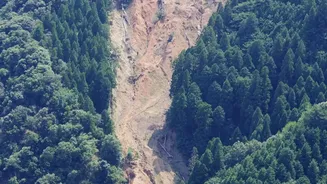







Assess Your Home's Location
The first step is understanding your specific risk. Landslides are most common near steep slopes, at the base of mountains, or along drainage channels. The Brihanmumbai Municipal Corporation (BMC), often using data from the Geological Survey of India
(GSI), identifies and classifies landslide-prone areas. Residents should contact local officials to learn if their property falls within a designated hazard zone. Past landslides are a strong predictor of future events, so researching your area's history is crucial. Look for physical clues like old landslide paths, tilted trees or poles, and cracks in the ground, which indicate that the earth has shifted before.
Recognise Imminent Warning Signs
Nature often provides warning signs before a landslide. Being able to spot them can provide critical time to evacuate. One of the most important signs is new cracks appearing in the ground, especially near the top of a slope. Other signals include doors or windows sticking for the first time, new cracks in walls or foundations, and exterior walls or stairs pulling away from the building. Pay close attention to water. New springs, seeps, or unusually saturated ground in areas that were previously dry are red flags. Listen for unusual sounds like rumbling, trees cracking, or boulders knocking together, which can indicate moving debris. A sudden change in creek or stream water, from clear to muddy, also suggests upstream ground disturbance.
Manage Water and Drainage
Water is the most common trigger for landslides because it saturates and weakens the soil. Effective water management around your property is one of the most powerful preventative tools. Ensure your home has a proper drainage system, including gutters and downspouts, that directs rainwater away from slopes and your home's foundation. Regularly clean these drainage pathways to prevent blockages, especially before and during heavy rains. Avoid letting water accumulate anywhere on or above a slope. Digging small diversion ditches can help channel surface runoff toward safe areas like a street or a well-vegetated zone. If you use irrigation, opt for methods like drip systems that minimize runoff.
Reinforce Your Property and Slopes
For homes on or near slopes, structural reinforcements can offer significant protection. Planting vegetation with deep root systems is one of the most effective ways to stabilize soil and prevent erosion. Grasses, shrubs, and trees act as natural anchors. For steeper slopes, consider consulting a professional about building retaining walls or terracing the landscape. Retaining walls can hold back soil, while terraces break up a long slope into smaller, flatter sections, which slows down water flow. In some cases, covering the slope with erosion control blankets or geotextiles can also prevent soil loss. It's vital these measures are designed by experts, as improperly built walls can fail.
Create a Family Emergency Plan
Knowing what to do in an emergency is just as important as prevention. Your family should have a clear evacuation plan. Identify safe routes to higher ground and designate a meeting place. Assemble a disaster supply kit with essentials like water, non-perishable food, a first-aid kit, a battery-powered radio, flashlights, and any necessary medications. During severe storms, stay alert and awake; many landslide fatalities occur when people are sleeping. If authorities issue an evacuation order, leave immediately. Recent events in Mumbai have shown that officials are increasingly willing to enforce evacuations in high-risk zones for resident safety.
What to Do During and After a Landslide
If a landslide is happening, move away from its path as quickly as possible. If you cannot escape, find cover under a sturdy piece of furniture, curl into a tight ball, and protect your head. After a slide, stay away from the affected area as secondary slides are common. Listen to local radio or news for emergency updates and instructions from authorities. Check for injured or trapped people without entering the direct slide zone and report their location to rescuers. Also, report any broken utility lines. Do not return to your home until officials have declared it safe, and consider having a professional engineer check the foundation for damage.