





The Challenge of Prime Real Estate
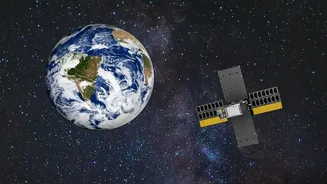
For satellites, location is everything. The closer they are to Earth, the better their performance. In what is known as Very Low Earth Orbit (VLEO), typically below 400 kilometers, satellites can capture higher-resolution images, provide faster communications
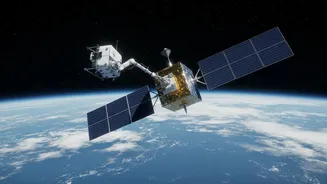
with lower latency, and require less powerful launchers to get there. But this orbital sweet spot comes with a major drawback: atmospheric drag. Though the air is incredibly thin, it’s dense enough to act like a constant brake on a satellite travelling at over 7 kilometers per second. This friction causes the satellite's orbit to decay, eventually pulling it back to Earth. To counteract this, satellites must fire thrusters, but this requires carrying heavy propellant, which limits their operational lifespan to just a few years before they run out of fuel. This constant need for re-boosting makes long-term VLEO missions expensive and unsustainable.
A Revolutionary 'Air-Breathing' Solution
Imagine a jet engine that works in the near-vacuum of space. That’s the core idea behind Air-Breathing Electric Propulsion (ABEP). Instead of carrying its own fuel, an ABEP-equipped satellite uses the very atmosphere that causes drag as its propellant. This technology, which has been in development by agencies like the European Space Agency (ESA) and Japan's JAXA, is designed to scoop up the sparse atmospheric particles and use them to generate thrust. By doing so, it directly counteracts the drag force, effectively making the flight 'drag-free' and allowing the satellite to maintain its orbit indefinitely without traditional fuel. This transforms the atmosphere from a mission-ending obstacle into a limitless source of fuel.
How to Breathe in Near-Vacuum
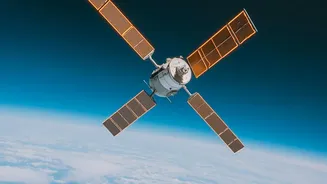
The process is remarkably elegant. An ABEP system consists of two main parts: a specially designed intake and an electric thruster. As the satellite speeds through its orbit, the intake collects and compresses the residual atmospheric gases, mostly nitrogen and oxygen. These collected molecules are then channeled into the electric propulsion unit. Inside, the gases are ionized—turned into a plasma by stripping electrons from the atoms—using power generated by the satellite's solar panels. This electrically charged plasma is then accelerated by electric and magnetic fields and expelled at extremely high velocity, producing a steady, gentle thrust. This thrust is precisely calculated to equal the force of the atmospheric drag, keeping the satellite perfectly stable in its orbit.
The Promise of Sustainable Orbits
The implications of this technology are enormous. By eliminating the need for onboard propellant, ABEP systems can dramatically extend the life of satellites in VLEO from a couple of years to potentially decades. This ushers in an era of highly sustainable space missions. Sustainability here has a dual meaning: longer-lasting, more cost-effective operations and a cleaner space environment. Satellites in VLEO naturally de-orbit and burn up upon mission completion, meaning they don't contribute to the growing problem of space debris in higher, more permanent orbits. This 'self-cleaning' aspect of VLEO makes it an inherently more responsible place to operate, especially with the rise of satellite mega-constellations.
What This Means for Earth
This isn't just an abstract engineering feat; it has tangible benefits for life on the ground. Long-duration VLEO missions enabled by ABEP will lead to better Earth-observation services, with sharper and more frequent imagery for monitoring climate change, managing natural disasters, and optimizing agriculture. It can also improve global telecommunications, offering lower latency for everything from financial trading to rural internet access. Furthermore, it opens up new possibilities for scientific research by allowing continuous study of the upper atmosphere. As research projects from ESA, JAXA, and commercial firms continue to advance the technology from successful ground tests toward in-orbit demonstrations, the prospect of a permanent fleet of air-breathing satellites is moving from science fiction to reality.