


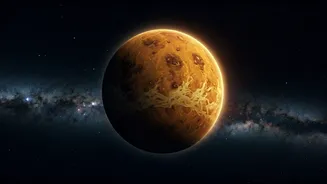


A Day Longer Than a Year
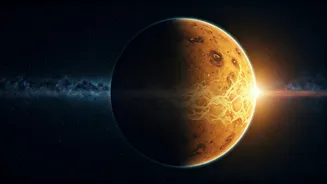
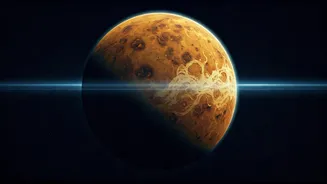
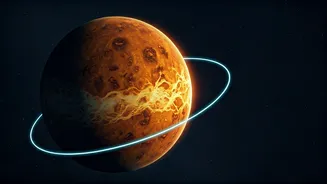
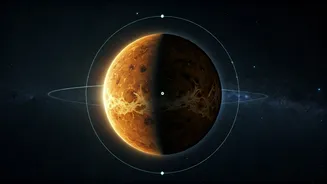
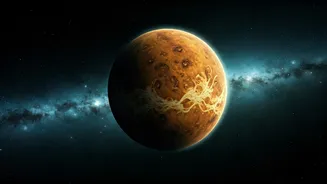
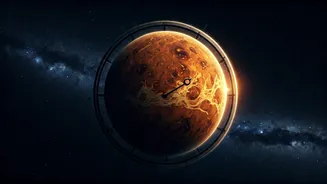
Let’s get straight to the mind-bending numbers. A year on any planet is the time it takes to complete one orbit around its star. For Venus, that journey around the Sun takes about 225 Earth days. This is its year. Now, for the day. A day is the time it takes for a planet to spin
once on its axis. On Venus, this single rotation takes an astonishing 243 Earth days. That’s right: a single Venusian day is 18 Earth days longer than a Venusian year. If you were standing on its surface, you would complete a full trip around the Sun before the planet under your feet finished one full spin. This fundamental mismatch is what astrophotographers and space enthusiasts find so endlessly fascinating. It breaks every intuitive rule we have about how time and celestial mechanics should work, all based on our experience here on Earth.
Unpacking the Venusian Clock
The situation gets even stranger when you consider what a “day” truly means. The 243-day figure is a sidereal day—one complete 360-degree rotation relative to the distant stars. But what about a solar day, the time from one sunrise to the next? Because Venus rotates backwards (a phenomenon called retrograde rotation) compared to Earth and most other planets, the sun appears to rise in the west and set in the east. This retrograde motion, combined with its slow spin, means that the time between sunrises is significantly different. A solar day on Venus is about 117 Earth days long. This means you’d experience roughly two sunrises for every full orbit of the Sun. So, while a single spin takes forever, the cycle of light and dark is (relatively) shorter. It's a confusing, counter-intuitive clockwork that makes Venus one of the solar system’s greatest oddities.
Why Is Venus So Bizarre?
Scientists don't have a single, definitive answer for Venus's strange behaviour, but they have compelling theories. The leading hypothesis points to its incredibly thick, heavy atmosphere. Composed almost entirely of carbon dioxide, the Venusian atmosphere is about 92 times more massive than Earth's, creating surface pressure that would crush a submarine. This dense blanket of gas is thought to exert a powerful frictional drag on the planet's surface, slowing its rotation over billions of years. Another theory suggests that a massive collision with another planetary body in the distant past could have sent it spinning in the opposite direction, or at least dramatically altered its original rotation. It's also possible that a complex interplay of gravitational tugs from the Sun and other planets created tidal forces that locked it into this strange, slow, backward spin. The truth is likely a combination of these factors, making Venus a captivating cosmic puzzle.
The View from the Telescope
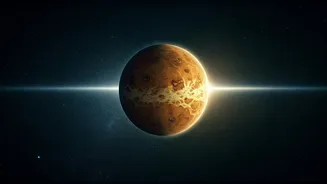
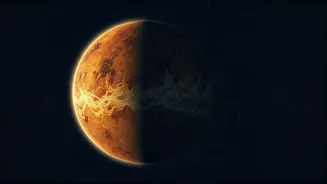
For the astrophotography community, this temporal disparity adds a layer of profound mystique to the planet. Venus is the brightest object in our night sky after the Moon, often called the “Morning Star” or “Evening Star.” However, its surface is permanently shrouded by thick, highly reflective clouds of sulfuric acid. Amateur photographers can't resolve surface features from Earth-based telescopes. Instead, they capture the planet’s beautiful phases, similar to our Moon’s. But knowing that beneath those serene clouds lies a world with such a warped sense of time elevates the act of observation. It's not just another bright dot; it’s a world with a day longer than its year, a backwards rotation, and crushing pressures. This context transforms a simple photograph of a bright crescent into a portrait of one of the most extreme and alien environments in our solar system. The challenge isn't just capturing the light, but appreciating the mind-boggling physics behind it.