








The Mission’s Pioneering Path
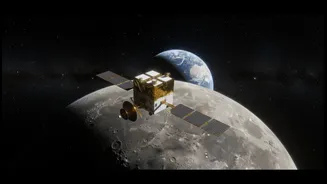
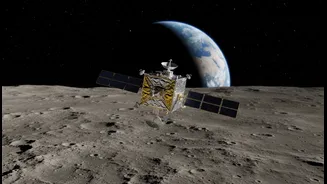
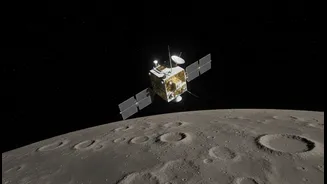
Launched in June 2022, the Cislunar Autonomous Positioning System Technology Operations and Navigation Experiment, or CAPSTONE, had a highly specific goal. Its primary job was to be the first spacecraft to enter and operate in a special lunar orbit known
as a near-rectilinear halo orbit (NRHO). This unique, highly elongated orbit is located at a gravitational balance point between the Earth and the Moon, making it remarkably stable and fuel-efficient for long-term missions. Think of it as a perfectly placed lay-by on the highway to the Moon, an ideal staging post for future missions to the lunar surface and beyond. CAPSTONE’s purpose was to fly this path, testing whether the computer models and simulations held up in the real world.
A Low-Cost Pathfinder
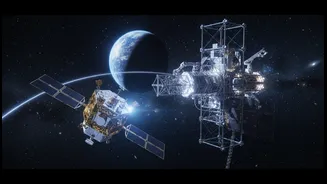
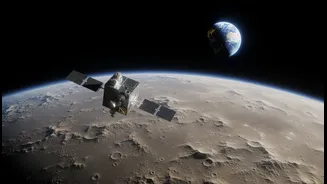
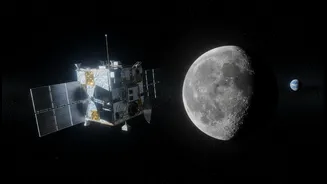
Weighing just 55 pounds, the microwave-sized CAPSTONE spacecraft is a prime example of the modern, cost-effective approach to space exploration. Instead of building and launching a massive, multi-billion dollar space station and hoping the orbit worked as planned, NASA used this small pathfinder to gather data first. The mission was designed to reduce risk for the future Lunar Gateway, the planned human-tended outpost for the Artemis program. By sending a small, relatively inexpensive probe to validate the orbit's power and propulsion needs, NASA could make informed decisions about the Gateway's design and operational logistics, saving immense amounts of time and money down the line.
What CAPSTONE Proved
By all accounts, CAPSTONE has been a resounding success. It successfully entered the NRHO in November 2022 and has been operating there since, completing its primary and extended mission objectives by mid-2026. The mission validated that the orbit is as stable and efficient as models predicted. It also demonstrated innovative spacecraft-to-spacecraft navigation technology, communicating with NASA’s Lunar Reconnaissance Orbiter (LRO) to determine its own position without having to rely solely on signals from Earth. This peer-to-peer navigation is a foundational technology that will be critical as cislunar space becomes a busier place. CAPSTONE provided the real-world operational experience needed to confirm that the NRHO is a viable and advantageous location for future lunar infrastructure.
Context, Not a Guarantee
Here is where the distinction in the headline becomes critical. CAPSTONE’s success is a vital piece of the puzzle, but it is just one piece. It proves the road is safe to drive on, but it doesn't build the car or guarantee the driver is ready. The challenges of constructing, assembling, and operating the Lunar Gateway are many times more complex than flying a small probe. The Gateway will involve integrating large modules launched separately, managing life support systems, dealing with the harsh radiation environment of deep space, and orchestrating complex rendezvous and docking procedures. Proving the orbit is stable is a different and far simpler task than building and maintaining a habitable outpost within it. Issues like managing mass budgets, integrating hardware from different commercial partners, and ensuring long-term reliability present engineering challenges of a completely different magnitude.