





A World of Surprises
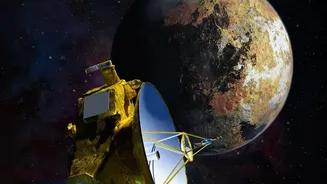
For decades, Pluto was just a faint point of light in our most powerful telescopes. Many expected it to be a simple, inactive, cratered ice ball. But when NASA's New Horizons spacecraft flew past it in 2015, it revealed a world of stunning complexity.
We saw towering mountains made of water ice, vast plains of frozen nitrogen, and a surface that appeared surprisingly young and varied. This immediately told scientists that the small, frigid world was far more geologically active than anyone had predicted. Instead of a dead world, Pluto presented a live canvas of ongoing geological change, preserving evidence that is erased on more volatile planets like Earth.
The Mystery of Ice Volcanoes
Unlike Earth's volcanoes which spew molten rock, cryovolcanoes erupt a slushy mix of water ice, nitrogen, and ammonia. On Pluto, scientists have identified several features, including two huge mounds named Wright Mons and Piccard Mons, that appear to be enormous ice volcanoes. Some may be as tall as 7 kilometres. One feature, Kiladze, was once thought to be an impact crater but is now suspected to be a massive caldera, similar to the supervolcano at Yellowstone. These structures suggest that Pluto's interior has been warm enough, recently or even now, to cause this icy material to erupt onto the surface, reshaping the landscape.
A Heart That Never Stops
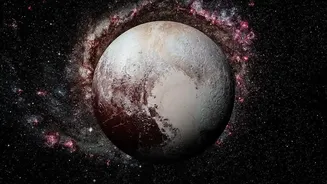
Perhaps Pluto's most famous feature is Tombaugh Regio, its giant heart-shaped plain. The western lobe of this heart, Sputnik Planitia, is a massive glacier made of frozen nitrogen larger than Texas and Oklahoma combined. This isn't a static sheet of ice. The surface is broken into city-sized polygonal cells that are constantly, slowly churning like a lava lamp in a process called convection. This process continually renews the surface, which is why it is almost completely free of impact craters. New research from 2026 suggests that liquid nitrogen from beneath the glacier may be occasionally seeping up through cracks to flow on the surface, leaving dark stains that New Horizons photographed. This is the first evidence of recent liquid flow on Pluto.
A Frozen Time Capsule
The answer lies in its extreme cold and thin atmosphere. On Earth, evidence of ancient geology is wiped away by wind, rain, and shifting continents. On Pluto, where surface temperatures plunge below -200°C, these processes are either non-existent or happen incredibly slowly. The weak atmosphere doesn't cause significant erosion, and the intense cold essentially freezes geological evidence in place. This makes Pluto a unique natural laboratory. Features like landslides, which were only recently identified in New Horizons data, and ridges that might be ancient glaciers offer clues into the planet's long history, preserved for billions of years.
Clues to a Hidden Ocean
One leading theory is that Pluto retains enough heat from its formation and from the decay of radioactive elements in its core. This heat might be enough to sustain a vast ocean of liquid water deep beneath its icy crust. The very presence and location of Sputnik Planitia, which likely formed in a giant impact basin, suggest the crust is weaker there, potentially due to an underlying ocean. The evidence preserved on Pluto's surface, therefore, isn't just telling us about the planet's past; it's providing the strongest hints yet about a hidden, liquid interior on one of the solar system's most distant worlds.