




The Challenge of Predicting Thirst
For years, scientists trying to forecast how tropical forests will respond to drought have faced a complex puzzle. The prevailing wisdom was that the tallest trees were the most vulnerable. It makes intuitive sense: pumping water hundreds of feet into
the air against gravity is a massive effort, and any water shortage should hit these giants the hardest. As a result, many risk models focused on the intricate internal plumbing, or 'hydraulic traits,' of these large trees. This involved difficult and time-consuming measurements, making it hard to apply these models at a large scale. Scientists needed a simpler, yet equally accurate, way to assess risk across vast, diverse forests like those in India's Western Ghats or the dense jungles of the Northeast.
A Breakthrough by Looking Down
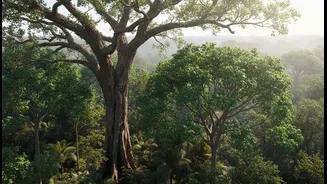
Recent research has turned this old assumption on its head. A study published in the journal Science revealed that many of the world's tallest tropical trees have evolved sophisticated ways to cope with drought. They can widen the water-carrying vessels, called xylem, at their base and adjust the physiology of their leaves to prevent water loss. But the biggest breakthrough came from comparing these giants to their smaller, understory neighbours. By analysing both tall and small trees, researchers discovered a more straightforward set of indicators that predict drought resilience for the entire ecosystem. It turns out that looking at just one part of the forest, the very top, gives an incomplete picture.
From Complex Hydraulics to Simple Traits
The new approach moves away from measuring the complex, moment-to-moment water pressure inside a tree. Instead, it focuses on more stable, observable traits. For example, some small understory trees show a surprising ability to adjust their carbon metabolism during long droughts, a sign of high resilience. In contrast, some of the tallest trees, despite their clever plumbing, may have smaller safety margins for survival. The key finding is that the drought response is not just about a tree’s height but about an interplay of factors across the entire forest structure. By studying a combination of both large and small trees, scientists can build models that are not only more accurate but also far more practical to implement, as they rely on data that is easier to collect.
Why the Whole Forest Matters
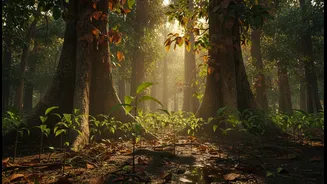
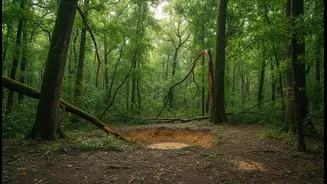
A forest is more than a collection of individual trees. The towering canopy trees and the smaller ones in the understory create a complex, interconnected system. The giants, which store a disproportionate amount of carbon, shape the environment below them. However, the smaller trees are crucial for the forest's future, representing the next generation. Studies show that while severe drought can increase mortality in larger trees, smaller trees often have a greater capacity to adapt. Therefore, a truly resilient forest is one where all levels are functioning well. The new modelling approach acknowledges this, providing a holistic view that accounts for how different parts of the forest respond to stress, leading to a much more robust prediction of overall vulnerability.
A New Tool for India's Forests
These findings have profound implications for India. With vast tropical and subtropical forests facing the dual pressures of climate change and increasing drought frequency, effective management is critical. The older, complex models were difficult to apply across the sheer diversity of Indian forest ecosystems. This new, more practical approach could be a game-changer. By sampling a strategic mix of tall and small trees, forest managers and scientists in India can develop more accurate, localised risk maps. This would allow for targeted conservation efforts, helping to identify and protect the most vulnerable forest patches before a devastating drought hits, safeguarding both the immense biodiversity and the critical carbon stocks these forests hold.