






Catching Starlight Through an Alien Sky
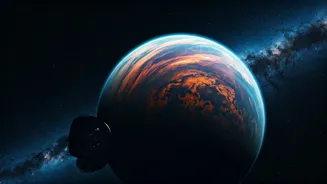
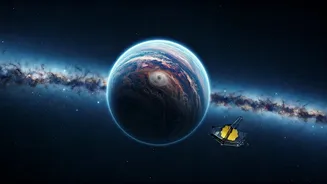
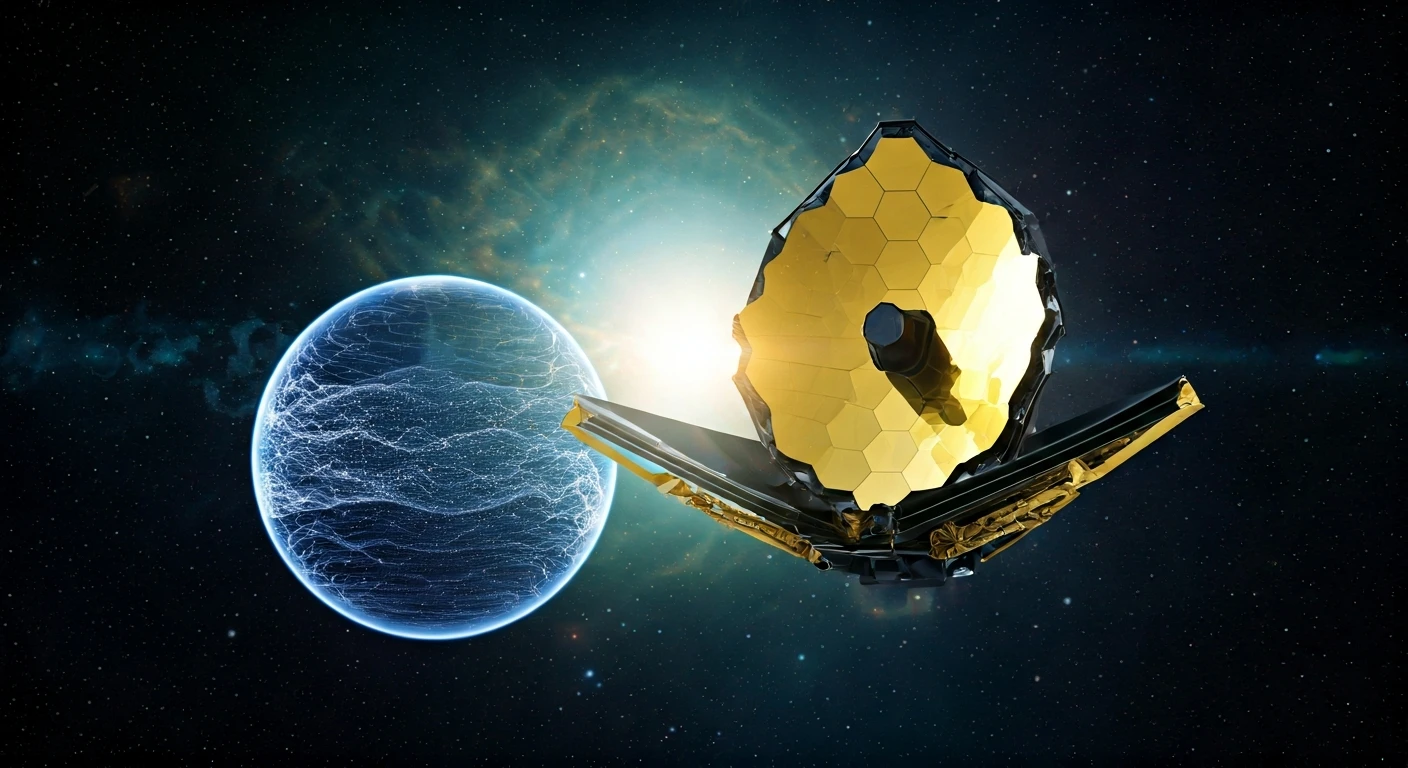
The primary method the James Webb Space Telescope uses is called transmission spectroscopy. Imagine a planet, hundreds of light-years away, passing in front of its host star from our point of view. This event is called a transit. As the starlight shines
through the edge of the planet's atmosphere, the gases present absorb very specific colours, or wavelengths, of that light. Each atom and molecule has a unique barcode-like signature of light that it absorbs. By capturing the starlight before and during the transit, astronomers can see exactly which colours are missing. Those missing pieces reveal the chemical makeup of the alien atmosphere.
Why Infrared Is the Key
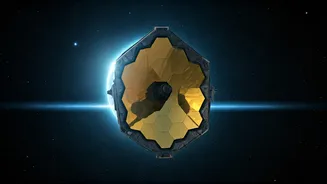
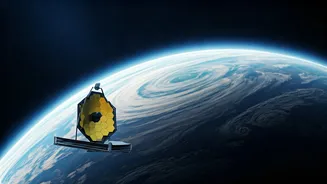
While the Hubble Space Telescope could perform some atmospheric analysis, JWST is a game-changer because it is optimized to see the universe in infrared light. Many of the most important molecules for life, including water (H₂O), methane (CH₄), and carbon dioxide (CO₂), have strong, clear absorption signatures in the infrared part of the spectrum. Visible light, which Hubble primarily uses, doesn't reveal these fingerprints nearly as well. JWST's massive, gold-coated mirror and its location far from Earth's heat allow it to pick up these faint infrared signals with unprecedented sensitivity, making it the perfect tool for sniffing out water across the cosmos.
A Toolkit for Cosmic Chemistry
To perform this cosmic chemistry, JWST uses a suite of highly advanced instruments called spectrographs, which are what actually split the light into a rainbow-like spectrum for analysis. The two workhorses for analysing exoplanet atmospheres are NIRSpec (Near-Infrared Spectrograph) and MIRI (Mid-Infrared Instrument). NIRSpec covers the near-infrared range (0.6 to 5.3 microns), which is ideal for detecting the signatures of water and other key molecules. MIRI extends that view further into the mid-infrared (5 to 28 microns), providing crucial data on cooler objects, different molecular bonds, and dusty environments. Often, data from both instruments, and sometimes a third called NIRISS, are combined to get the most complete picture of an atmosphere's composition.
From Data to Discovery
The data that comes back from JWST isn't a simple 'water: yes/no' answer. It arrives as complex graphs showing the brightness of light at thousands of different wavelengths. Scientists then use sophisticated computer models to compare these observed spectra to models of atmospheres with different chemical mixtures. When the dips in the observed data perfectly match the known absorption pattern for water, they can confirm its presence. For example, observations of the gas giant WASP-96 b showed the unambiguous signature of water. In other cases, like the rocky exoplanet GJ 486 b, the signal is more complex, and scientists must carefully rule out other sources, like water vapour in the cool spots of the host star itself, before declaring a planetary atmosphere. This meticulous analysis allows them not just to detect water, but to begin estimating its abundance and the planet's atmospheric temperature.