



A Sweet Discovery in the Stars
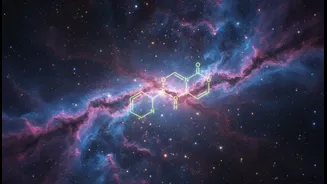
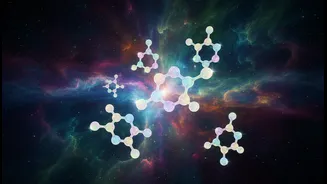
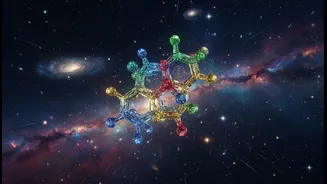
Scientists have announced the first-ever detection of a four-carbon sugar, known as erythrulose (C4H8O4), in the interstellar medium. This complex molecule was identified in a dense and chemically rich molecular cloud named G+0.693-0.027, located approximately
26,745 light-years from Earth near the Milky Way's core. While simpler molecules, including two-carbon sugar relatives, have been found in space before, this is the first time a true, more complex sugar has been directly observed floating in the cosmic soup from which stars and planets form. On Earth, erythrulose is a sugar found naturally in raspberries. Its presence in the void between stars is a profound discovery that strengthens the theory that the building blocks for life may have cosmic origins.
The Cosmic Detective Work
Pinpointing a single type of molecule in a vast gas cloud trillions of kilometres away is a monumental task. An international team of researchers, led by scientists from Spain, used a pair of powerful radio telescopes—the 40-meter Yebes Observatory and the 30-meter IRAM telescope—to achieve this feat. Every molecule rotates and vibrates at specific frequencies, creating a unique spectral 'fingerprint'. The team carefully scanned the emissions from the molecular cloud and detected 12 distinct spectral lines that perfectly matched the laboratory signature of erythrulose, confirming its presence with a very high degree of certainty. This method, known as radio astronomy, allows scientists to identify the chemical composition of distant cosmic objects without ever leaving Earth.
More Than Just a Simple Sugar
The discovery is significant not just because a sugar was found, but because of its complexity. The detection challenges previous assumptions about how large molecules form in space. Scientists were surprised to find that erythrulose was at least eight times more abundant than any simpler, three-carbon sugars. This suggests that complex molecules might not always build up sequentially, one carbon atom at a time. Instead, computer simulations indicate that erythrulose likely forms on the icy surfaces of cosmic dust grains, where two-carbon fragments combine directly, triggered by the constant bombardment of cosmic rays. This discovery opens up new possibilities for how the chemical precursors to life can assemble themselves under the harsh conditions of interstellar space.
A Stepping Stone to Life
While erythrulose itself is not an essential component of life as we know it, its existence has major implications for astrobiology. The genetic molecules DNA and RNA, which form the blueprint for all known life, use a five-carbon sugar called ribose in their backbone. However, scientists have long debated how ribose could have formed on early Earth, as it is difficult to synthesize. One leading theory suggests that life may have first used a simpler genetic polymer, Threose Nucleic Acid (TNA), which is built on a four-carbon sugar called threose. Crucially, in the presence of water, erythrulose can easily be converted into threose, providing a direct chemical pathway from a molecule found in interstellar clouds to a plausible ancestor of RNA. This strengthens the hypothesis that comets and asteroids, which formed from this same interstellar material, could have delivered these vital ingredients to a young Earth billions of years ago.