

Why Venus? Earth's Mysterious Sibling
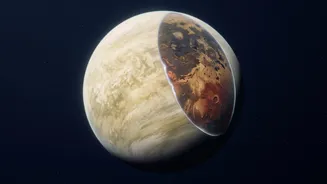
Venus and Earth are similar in size, mass, and composition, yet they followed vastly different evolutionary paths. While Earth became a haven for life, Venus turned into a scorching inferno with surface temperatures hot enough to melt lead. Its thick
atmosphere, dominated by carbon dioxide, created a runaway greenhouse effect, a cautionary tale for our own planet. Scientists are fascinated by this divergence. Understanding why Venus became so inhospitable could provide invaluable insights into planetary evolution, climate change dynamics, and the conditions required for a planet to support life. The planet is perpetually covered by a dense layer of sulphuric acid clouds, which has made studying its surface and atmosphere a significant challenge.
Shukrayaan-1: India's Next Interplanetary Leap
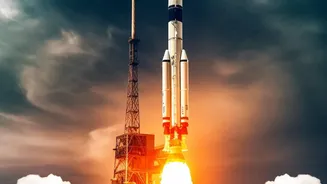
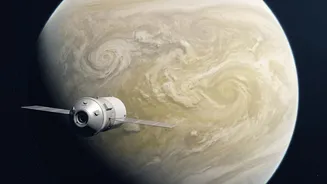
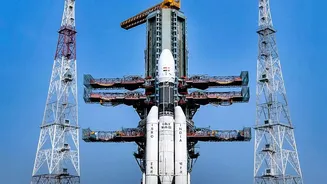
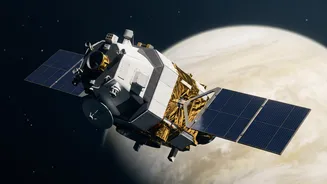
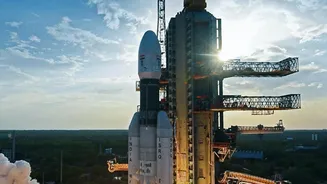
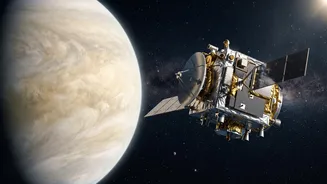
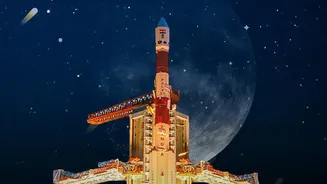
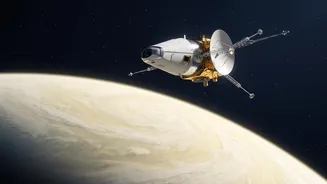
Following the historic successes of the Chandrayaan lunar missions and the Mangalyaan Mars orbiter, the Indian Space Research Organisation (ISRO) is setting its sights on our other planetary neighbour. Shukrayaan-1, which means "Venus Craft" in Sanskrit, is India's first dedicated mission to the planet. Approved by the Union Cabinet in 2024 with a significant budget, the mission is currently scheduled for a March 2028 launch aboard the powerful LVM-3 rocket. The orbiter is planned to study Venus for over four years, performing a comprehensive investigation of its surface, subsurface, and complex atmosphere. This mission places India in an elite club of space agencies aiming to unlock the secrets of the second planet from the Sun.
Decoding the Sulphuric Acid Clouds
A primary focus of the Shukrayaan mission is the chemistry of Venus's thick, corrosive cloud cover. These clouds are not made of water vapour, but of sulphuric acid, and they are a key driver of the planet’s extreme climate. The headline-making, though still debated, detection of phosphine gas in these clouds a few years ago also raised tantalizing questions about unknown chemical processes or even potential biological activity. Shukrayaan-1 will carry a suite of high-precision instruments designed specifically to analyze the composition of this toxic atmosphere. By studying the gases and their dynamics, ISRO scientists hope to understand more about active volcanism, atmospheric super-rotation, and the mysterious substance that absorbs ultraviolet radiation in the Venusian clouds.
An Impressive Toolkit of Indian-Led Sensors
At the heart of the mission is a payload of sophisticated, largely Indian-made instruments. The orbiter will carry around 100 kg of scientific equipment. One of its flagship instruments is a high-resolution Synthetic Aperture Radar (SAR), which can peer through the dense clouds to map the planet's surface with unprecedented detail, potentially four times the resolution of NASA’s Magellan mission from the 1990s. Shukrayaan-1 will also be the first-ever mission to use a ground-penetrating radar at Venus, allowing scientists to study the shallow subsurface for the first time. Other Indian instruments include thermal cameras, cloud monitoring tools, and spectrometers to investigate the atmosphere from top to bottom.
A Global Effort Led by India
While driven by Indian ingenuity, Shukrayaan-1 is also a significant international collaboration. Sweden is contributing a key instrument called the Venusian Neutrals Analyser (VNA), which will study how the solar wind interacts with the planet's atmosphere. This instrument is part of a larger Indian-developed payload called VISWAS. France and Russia are jointly providing the Venus Infrared Atmospheric Gases Linker (VIRAL) instrument, which will contribute to the study of atmospheric chemistry. This mission joins a new global wave of interest in Venus, with NASA and the European Space Agency also planning missions like DAVINCI, VERITAS, and EnVision for the coming decade. India’s mission is poised to provide a unique and comprehensive dataset that will complement these other efforts.