




Putting the ‘Slow’ in Rotation
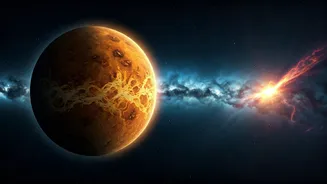
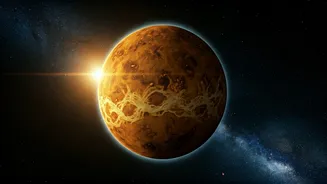
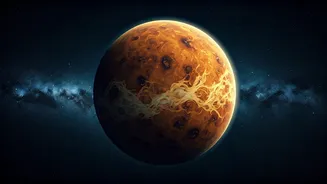
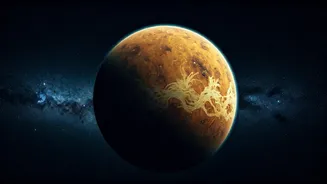
When we say Venus has a slow rotation, it’s a cosmic understatement. While Earth completes a full spin on its axis in about 24 hours, Venus takes a leisurely 243 Earth days to do the same. This is its sidereal day—the time it takes to rotate once relative
to the distant stars. Imagine a single day lasting for more than eight months. This incredibly sluggish pace is the slowest of any planet in our solar system. If you could stand on Venus, you wouldn't feel the planet turning beneath you. The sun would appear to crawl across the sky at an almost imperceptible rate, creating brutally long periods of daylight and darkness.
A Day Longer Than a Year
Here is where things get truly strange. Venus orbits the Sun in approximately 225 Earth days. Since its rotational period (a 243-Earth-day-long sidereal day) is longer than its orbital period, a single day on Venus is longer than its year. This is a mind-bending concept unlike anything we experience on Earth. However, because the planet is also moving around the Sun, the length of a solar day—the time from one sunrise to the next—is different. Factoring in its orbit, a solar day on Venus works out to be about 117 Earth days. So, you’d experience roughly two sunrises for every trip Venus makes around the Sun. It’s a calendar that would drive anyone mad.
Spinning the Wrong Way
As if its snail's pace wasn't odd enough, Venus also spins backwards. Nearly all planets in our solar system, including Earth, rotate on their axis in a counter-clockwise direction when viewed from above the Sun's north pole. This is called prograde rotation. Venus, however, exhibits retrograde rotation, spinning clockwise. The only other planet to do this is Uranus, which is tilted so far on its side it's almost rolling along its orbit. This backward spin means that if you were on Venus, the Sun would appear to rise in the west and set in the east. This unusual combination of slow and backward rotation makes Venus a true outlier in our planetary family.
What Caused This Bizarre Spin?
Scientists don't have a single definitive answer, but there are two leading theories. The first involves a catastrophic past. Early in its history, Venus might have been struck by a massive planet-sized object. Such a powerful collision could have dramatically slowed its original rotation and even flipped it upside down, resulting in its current retrograde spin. The second theory is less dramatic but equally fascinating. It suggests that Venus's incredibly thick atmosphere is to blame. Over billions of years, the gravitational pull of the Sun on the planet’s dense, heavy atmosphere created strong atmospheric tides. This constant friction between the solid planet and its soupy atmosphere could have acted like a powerful brake, gradually slowing its spin to its current crawl.
The Hellish Consequences of a Slow Day
This bizarre rotation isn't just a cosmic quirk; it has profound effects on the planet's environment. The long days and nights create extreme temperature swings, though they are moderated by the thick atmosphere. The planet’s surface is a scorching 465°C, hot enough to melt lead, day or night. This is due to a runaway greenhouse effect, where its dense carbon dioxide atmosphere traps heat. Furthermore, while the planet itself turns slowly, its upper atmosphere whips around the planet once every four Earth days in a phenomenon called “super-rotation.” Scientists believe the slow rotation of the planet itself is a key ingredient in allowing these hurricane-force winds to persist, turning Venus into the hostile, toxic inferno we know today.