







Cosmic Lighthouses in the Deep
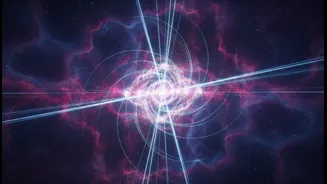
Imagine the collapsed core of a massive star, an object with more mass than our sun crushed into the size of a city. Now, imagine it spinning hundreds of times per second. This is a pulsar, one of the universe's most extreme creations. Due to their intense
magnetic fields, these rapidly rotating neutron stars emit powerful beams of radiation from their poles. As the pulsar spins, these beams sweep across the cosmos. If one of these beams happens to sweep past Earth, our radio telescopes detect a regular, repeating pulse—much like a ship spotting the rhythmic flash of a distant lighthouse. It is this incredible regularity that makes them more than just a curiosity; it makes them a tool.
An Invisible Magnetic Skeleton
Our Milky Way galaxy isn't empty space dotted with stars. It is filled with a tenuous, spread-out mixture of gas and dust called the interstellar medium. Woven throughout this medium is a vast, complex, and almost entirely invisible web: the galactic magnetic field. This field is incredibly weak, far weaker than a refrigerator magnet, but over galactic distances, it is a powerful force. It influences the birth of stars, guides the path of cosmic rays, and, as scientists have long suspected, plays a crucial role in shaping some of the largest structures in the universe. The problem has always been how to map a structure that you cannot directly see. This is where the lighthouses come in.
Mapping the Unseen
The light from a pulsar is polarized, meaning its waves oscillate in a specific direction. As this polarized light travels for thousands of years through the interstellar medium to reach us, the galactic magnetic field subtly twists its direction of polarization. This phenomenon is known as Faraday rotation. By measuring the extent of this twist from a single pulsar, astronomers can determine the strength of the magnetic field along that specific line of sight. By observing thousands of pulsars scattered across the galaxy, they can combine these individual lines of sight to build up a comprehensive, three-dimensional map of the entire galactic magnetic field. This ambitious project is what the headline refers to as the 'Lighthouse Pulsar Map,' an effort enabled by powerful radio telescopes and missions like NASA's IXPE, which studies polarization.
The Mystery of Cosmic Jets
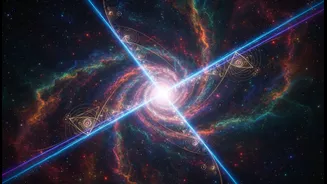
At the centers of many galaxies, including our own, lurk supermassive black holes. As these behemoths feed on surrounding gas and dust, they don't swallow everything. Instead, they can launch enormous, focused streams of ionized matter and energy, known as astrophysical jets, from their poles at nearly the speed of light. These jets are colossal, capable of stretching for thousands, or even millions, of light-years, far beyond the boundaries of their host galaxy. For decades, scientists have believed that magnetic fields are the key ingredient that confines and focuses this material into such tight beams, acting like a cosmic nozzle. However, understanding how these jets behave once they travel far from the black hole and interact with the wider galaxy has remained a major puzzle.
Connecting Lighthouses and Jets
This is where the pulsar map becomes essential. A detailed map of the galactic magnetic field provides the missing context. It allows astrophysicists to model how these immense jets, after being launched by the magnetic fields near a black hole, are then bent, twisted, or disrupted by the larger magnetic structure of the host galaxy. Recent observations, such as those of the 'Lighthouse Nebula' by NASA's IXPE telescope, have already confirmed on a smaller scale that particles escaping a pulsar follow the direction of the local magnetic field. Applying this principle on a galactic scale, the pulsar map can help explain why some jets are straight and narrow while others appear bent or fragmented. It offers a way to test and refine our theories about the most powerful phenomena in the cosmos.