


In the high-stakes, cash-flush world of artificial intelligence, a brother-sister duo is carving a unique path. They left top jobs at OpenAI to build a rival, Anthropic, founded on a principle that often seems at odds with Big Tech: safety first.
The Break From OpenAI
In 2021,
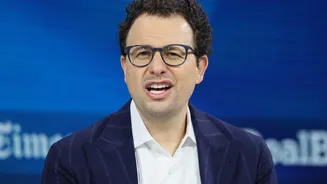
Dario and Daniela Amodei, along with several other senior members, departed from the industry-leading AI lab OpenAI. Dario had been the Vice President of Research, instrumental in developing models like GPT-2 and GPT-3, while Daniela was the Vice President of Safety and Policy. The split wasn't over a single event but a fundamental disagreement about the future direction of AI development. Dario has stated that it is 'incredibly unproductive to try and argue with someone else's vision'. He felt that to truly implement their safety-focused approach to building powerful AI, they needed to start fresh. This led them to found Anthropic, a new company with a different philosophy at its core.
A New Philosophy: Safety First
Anthropic was established as a Public Benefit Corporation, a structure that legally encodes its mission to balance profit with societal benefit. The company's central thesis is that AI safety is not an afterthought but a prerequisite. The Amodeis and their co-founders believed that as AI models become more powerful, the risks of them causing harm—whether through bias, misinformation, or other unpredictable behaviors—grow exponentially. Anthropic's mission is to build reliable, interpretable, and steerable AI systems. This means creating models that are not only powerful but also transparent and controllable, ensuring they remain aligned with human values. This safety-first approach is embedded in every stage of their research and development, from data training to deployment.
Building A 'Constitutional' AI
Anthropic's flagship product is Claude, a family of large language models designed to be helpful, honest, and harmless. Unlike other models trained primarily on vast, unfiltered internet data, Claude's development incorporates what Anthropic calls 'Constitutional AI'. This involves training the model with a 'constitution'—a set of principles derived from sources like the UN's Declaration of Human Rights—to guide its responses and refuse harmful requests. This technique, combined with Reinforcement Learning from Human Feedback (RLHF), aims to create a more ethical and predictable AI assistant. The latest models, the Claude 3 family (Opus, Sonnet, and Haiku), set new industry benchmarks for intelligence while also having sophisticated vision capabilities, allowing them to analyze images, charts, and diagrams.
The Billion-Dollar Bet on Caution
Anthropic's safety-conscious approach has not been a barrier to commercial success; in fact, it has become a key differentiator that has attracted massive investment. The company has secured billions in funding from tech giants like Google and Amazon. This financial backing has propelled Anthropic to a staggering valuation, recently hitting $965 billion after a Series H funding round, making it one of the most valuable AI companies in the world, rivaling even its progenitor, OpenAI. This record valuation is a powerful signal from the market that there is immense value and demand for an AI company that places responsible development at the center of its business strategy. Recent reports also indicate the company has gone public with a valuation of approximately $1.5 trillion.
A Sibling Power Dynamic
At the heart of this AI powerhouse is the unique partnership of its sibling co-founders. Dario, the CEO, is described as the 'ideological leader', setting the company's research direction and strategic vision for building steerable AI. With a PhD in biophysics and a deep background in machine learning at Google Brain and OpenAI, he guides the technical frontier. Daniela, as President, manages the day-to-day operations and executive team, translating that vision into a functional organization. Her experience in management and policy at Stripe and OpenAI complements her brother's research focus. Together, they've been recognized among the most influential people in AI, a testament to their shared vision and effective partnership in scaling a company from a small group of researchers to a global AI leader.