


A Sweet Discovery in a Surprising Place
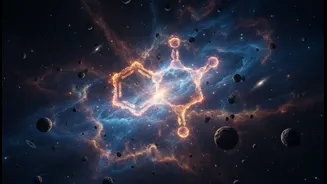
In a vast, turbulent cloud of gas and dust near the center of our Milky Way, scientists have detected the chemical signature of erythrulose, a four-carbon sugar. This discovery, made using radio telescopes in Spain, marks the first time a true sugar has
been identified in interstellar space. Located in a molecular cloud known as G+0.693-0.027, this isn't just any sugar; it's a molecule also found naturally in raspberries. While previous studies found simpler sugar-like molecules, such as glycolaldehyde, in space and even more complex sugars like ribose inside meteorites, finding erythrulose freely floating between the stars is a major leap. It suggests that the chemical processes in the universe are capable of creating surprisingly complex organic molecules long before stars and planets even form.
The Galactic Center's Chemical Factory
The heart of the Milky Way is a chaotic and extreme environment. Giant molecular clouds, spanning hundreds of light-years, are pummeled by radiation and twisted by immense gravitational forces from the supermassive black hole at the galaxy's core. Yet, it is within these seemingly hostile stellar nurseries that a rich and complex chemistry thrives. Regions like Sagittarius B2 and G+0.693-0.027 are known as cosmic chemical repositories. Here, atoms cling to the surfaces of icy dust grains, where frigid temperatures near absolute zero allow them to combine over millions of years into an ever-growing list of molecules, including alcohols like ethanol and the precursors to amino acids. These clouds act as giant factories, manufacturing the raw materials that will eventually be incorporated into new solar systems.
Listening for Life's Ingredients
Detecting a specific molecule from 27,000 light-years away is a remarkable feat of astronomical detective work. Astronomers use powerful radio telescopes like the Atacama Large Millimeter/submillimeter Array (ALMA) to listen for faint radio waves emitted by molecules in space. Every molecule vibrates and rotates at specific frequencies, creating a unique spectral "fingerprint." By pointing telescopes at a cloud and tuning them to the right frequencies, scientists can identify the chemical composition of the gas. To confirm the presence of erythrulose, researchers in Spain meticulously compared the signals from the G+0.693-0.027 cloud with the known laboratory signature of the sugar molecule, finding a perfect match.
Expanding the Recipe for Life
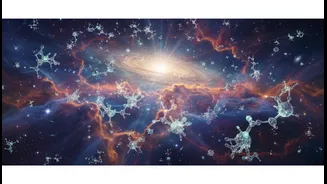
So, why is finding sugar in deep space so important? Sugars are fundamental to life as we know it. They provide energy, form structural components in cells, and, most critically, are part of the backbone of RNA and DNA, the molecules that carry our genetic code. The discovery of erythrulose and other complex organic molecules in the interstellar medium supports a fascinating theory: the building blocks of life are not unique to Earth. Instead, they may be universal, seeded throughout the galaxy. These prebiotic molecules, formed in cosmic clouds, can become trapped in the asteroids and comets that coalesce around young stars. These space rocks then act as a delivery service, crashing into fledgling planets and depositing their life-giving cargo. This process could have happened on early Earth, and it could be happening on countless other planets across the galaxy.