




A Historic Flyby
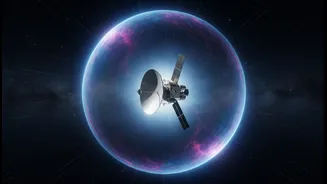
Launched in 2006, New Horizons became one of the fastest spacecraft ever to leave Earth. Its primary purpose was to conduct the first-ever close-up study of Pluto. For nearly a decade, it travelled across the solar system, a silent emissary on a 3-billion-mile
journey. On July 14, 2015, it succeeded spectacularly, flying just 12,500 kilometres above Pluto's surface. The data it sent back transformed our understanding of the dwarf planet, revealing towering mountains of water ice, vast nitrogen glaciers, and a surprisingly complex, hazy atmosphere. This encounter completed humanity's initial reconnaissance of the classical nine planets of our solar system, but for New Horizons, the work was just beginning.
The New Frontier
After Pluto, the mission was extended to explore the Kuiper Belt, a vast, icy debris field beyond Neptune's orbit that is believed to hold clues about the formation of our solar system. In 2019, New Horizons achieved another milestone by flying past Arrokoth, the most distant object ever explored by a spacecraft. Now, the probe continues its journey through this mysterious region. Its current extended mission, funded until 2028 or 2029, focuses on gathering data about the environment of the outer solar system and observing distant Kuiper Belt Objects (KBOs). While no new flyby targets are currently reachable, the team remains hopeful that one may be found, allowing for another close encounter at the edge of the solar system.
Running on Fumes
The greatest challenge for any future encounter is fuel. Space travel itself requires no fuel to coast through the vacuum, but thrusters are essential for making course corrections and pointing the spacecraft's antenna toward Earth. New Horizons was launched with about 77 kilograms of hydrazine propellant. While more than half of this was estimated to remain after the Pluto flyby, every maneuver uses up this finite resource. The team must be incredibly judicious, carefully planning each thruster firing to conserve as much fuel as possible for a potential future KBO flyby. This balancing act means that the mission's future ambitions are directly tied to the small amount of propellant left in its tank, billions of miles from any refuelling station.
An Aging Power Source
Equally critical is the spacecraft's power supply. Being too far from the Sun for solar panels, New Horizons relies on a Radioisotope Thermoelectric Generator, or RTG. This device converts heat generated by the natural decay of plutonium-238 into electricity. At its launch in 2006, the RTG provided about 245 watts of power. However, due to the fuel's decay, that output drops by about 3.5 watts each year. By the time it reached Pluto in 2015, power had already dropped to around 200 watts. The spacecraft has no battery to store power, so all systems must run directly off the RTG's steadily declining output. Mission planners must carefully manage a strict power budget, deciding which of the seven science instruments can be active at any given time.
Ingenuity at the Edge of Space
Keeping New Horizons functional is a testament to the ingenuity of its ground crew. The team uses periods of hibernation, sometimes lasting for months, to conserve power and reduce wear and tear on the systems. They develop clever software solutions and prioritize observations, squeezing every last drop of scientific potential from the aging probe. The mission has now shifted to focus heavily on heliophysics, studying the sun's influence at the far reaches of the solar system, a task that can be done with less active maneuvering. There is even a possibility that, like the Voyager probes before it, New Horizons could continue functioning long enough to exit the Kuiper Belt and become humanity's third active interstellar spacecraft.