



First, What Is Quantum Radar?
Imagine a radar system that works by tapping into the strange rules of quantum mechanics. That’s quantum radar in a nutshell. A conventional radar sends out a pulse of radio waves and listens for the echo. Quantum radar, in theory, does something far
more clever: it uses a phenomenon called quantum entanglement. Think of it like creating a pair of perfectly linked particles, or photons. You keep one at home (the 'idler' photon) and send the other one (the 'signal' photon) out into space. When the signal photon bounces off an object and returns, it still retains a special, ghostly connection to its twin. By comparing the returning photon to the one you kept, you can distinguish its faint signal from the overwhelming background noise of space with incredible precision. This makes it exceptionally good at finding things that are very hard to see.
A Game-Changer for Space Missions
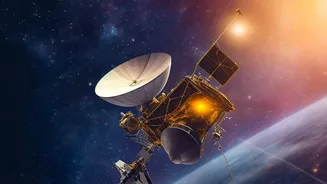
So why is ISRO interested in this for spacecraft? The applications are revolutionary. The primary advantage is its extreme sensitivity. It could allow a spacecraft to detect objects with very low reflectivity, like certain types of asteroids or space debris that are nearly invisible to conventional systems. This capability is crucial for space traffic management and planetary defense. Beyond detection, it could be used for imaging. A quantum radar might be able to peer through the dense, hazy atmospheres of planets like Venus or moons like Titan, revealing their surfaces in unprecedented detail. It could also provide highly secure communication channels, as any attempt to intercept the quantum signal would disturb it, immediately revealing the eavesdropper. For ISRO, mastering this technology means a leap in both scientific discovery and mission safety.
An AI Co-Pilot for Deep Space
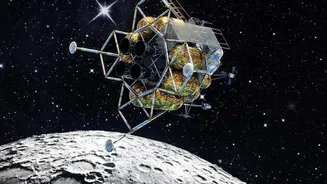
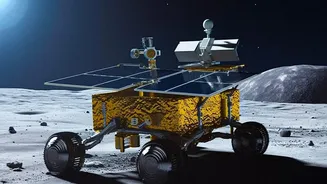
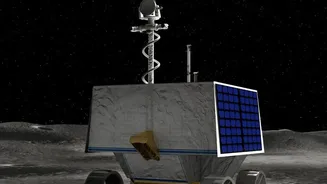
The other half of this futuristic vision is Artificial Intelligence. Sending missions to Mars or beyond involves huge communication delays. You can't just joystick a rover in real-time. This is where AI becomes essential. As NASA has demonstrated with its Mars rovers, AI allows a spacecraft to make its own decisions. It can autonomously navigate treacherous terrain, identify scientifically interesting targets, and monitor its own health, diagnosing and even fixing problems without waiting for instructions from Earth. ISRO experts have highlighted that on-board AI processing will enable real-time decision-making, which is critical for everything from disaster management support via satellites to navigating the unexplored regions of the solar system. It’s less about replacing human control and more about providing a smart, autonomous partner for missions where direct control is impossible.
ISRO's Blueprint for the Future
ISRO's leadership is vocal about the need to invest in these disruptive technologies. Former ISRO Chairman S. Somanath and other experts have repeatedly emphasized that AI, machine learning, and quantum technologies are not just theoretical pursuits but are fundamental to the agency's future roadmap. At a recent conclave, Dr. Nilesh M Desai, a former director at an ISRO center, explicitly stated that AI/ML and quantum tech will play a transformative role in India's upcoming satellite systems. This isn't about a single mission but a wholesale upgrade of capabilities. The goal is to build spacecraft that are more intelligent, perceptive, and resilient. This push is part of a broader vision to position India as a hub for space innovation, fostering collaboration between the national agency and a burgeoning private sector.
Why It Matters on a Global Scale
ISRO's investment in quantum radar and AI signals a significant shift in the international space landscape. For decades, the domain of highly advanced, almost theoretical space technology was dominated by the U.S. and Russia. China has since become a major force, and now India is making a clear statement of its ambitions. By developing these capabilities, ISRO is not just aiming for self-reliance; it's positioning itself as a key collaborator and a formidable competitor. For the United States and its allies, a more technologically advanced ISRO is a powerful potential partner for future missions to the Moon, Mars, and beyond, as seen in existing collaborations like the NISAR satellite mission with NASA. It reinforces that the future of space exploration will be a multi-polar endeavor, driven by a handful of nations pushing the absolute limits of science and engineering.