






The Sun's 11-Year Rhythm
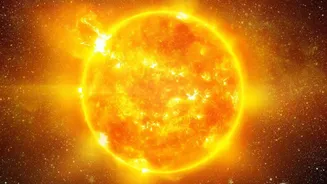
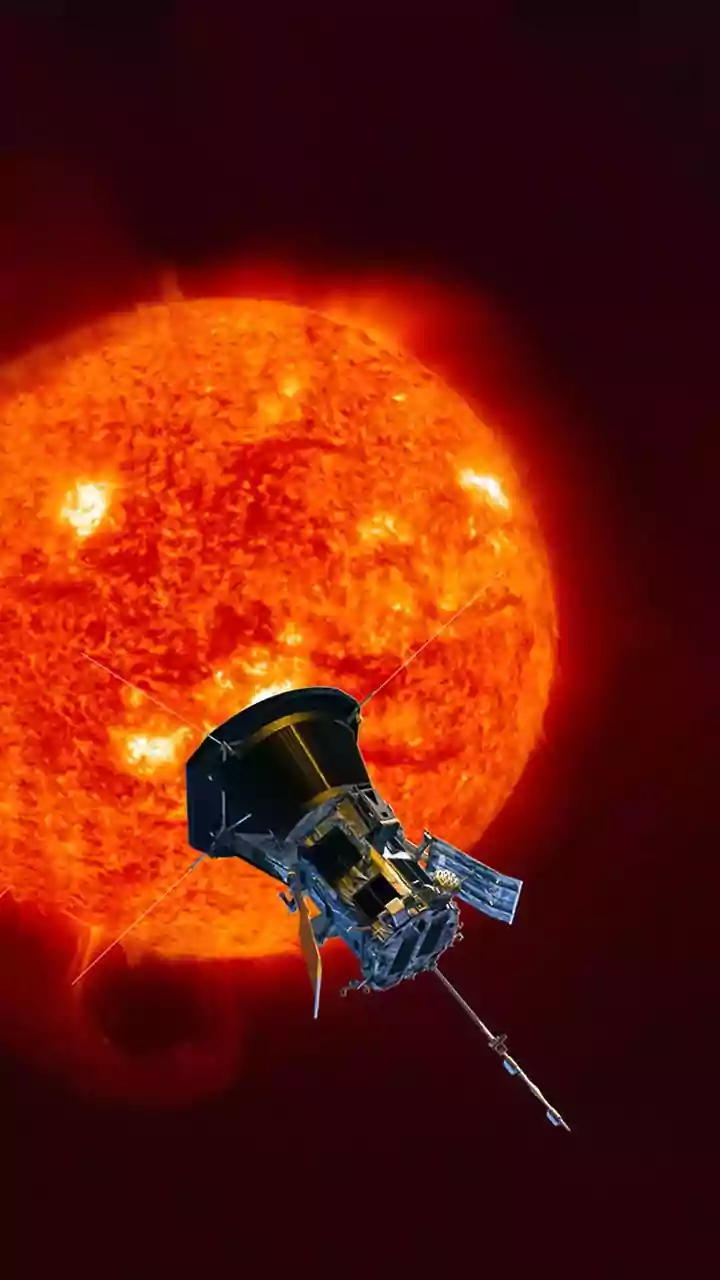
Just like the Earth has seasons, the sun goes through a natural cycle of activity that lasts roughly 11 years. This cycle swings between a quiet period, known as the solar minimum, and a turbulent peak called the solar maximum. We are currently in Solar
Cycle 25, which began in December 2019. Predictions indicate this cycle's maximum phase is occurring between 2024 and 2026, a period marked by a significant increase in sunspots, solar flares, and colossal eruptions of solar material known as Coronal Mass Ejections (CMEs). While initial forecasts suggested a mild cycle, Solar Cycle 25 has proven to be more active than expected, making this maximum a particular point of focus for space agencies worldwide.
How Solar Storms Threaten Satellites
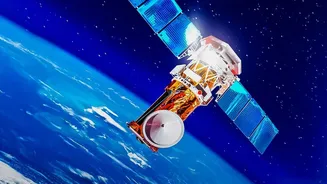
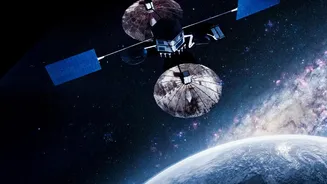
When a powerful solar flare or CME erupts from the sun, it sends a wave of radiation and charged particles hurtling through space. If Earth is in the path of this solar storm, our planet's magnetic field and atmosphere protect us on the ground, but satellites in orbit are highly exposed. There are several key risks. High-energy particles can bombard a satellite's sensitive electronics, causing malfunctions, system errors, or even permanent damage. This is sometimes called a 'phantom command,' where the satellite might execute an action, like firing a thruster, without being instructed to do so. Another issue is atmospheric drag; solar storms heat and expand Earth's upper atmosphere, increasing drag on satellites in low-Earth orbit, which can alter their trajectory and require fuel to correct. Finally, these storms can disrupt the very signals satellites transmit, leading to radio blackouts and scrambling GPS navigation.
The Global Watchtower
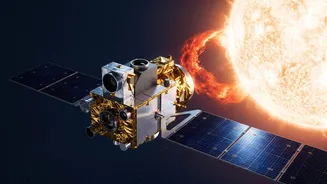
Given the stakes, a global network of scientists continuously monitors the sun. Space-based observatories, like NASA’s Solar Dynamics Observatory, and ground-based telescopes provide a constant stream of data on the sun's behaviour. Agencies like the US National Oceanic and Atmospheric Administration (NOAA) run space weather prediction centers that act as an early warning system. By observing the formation of sunspots and detecting eruptions as they happen, these centres can forecast the arrival time and potential intensity of a solar storm. This gives satellite operators crucial lead time—from a few minutes for a solar flare's radiation to a few days for a CME's particle cloud—to take protective measures. For India, the Indian Space Research Organisation (ISRO) plays a vital role in this effort, monitoring space weather to protect its own growing constellation of satellites.
Shielding Our Digital Lifelines
When a solar storm warning is issued, satellite operators have a playbook of defensive manoeuvres. The most common is to put the satellite into a 'safe mode.' This involves shutting down non-essential systems and orienting the spacecraft to protect its most sensitive components from the incoming radiation. For long-term protection, modern satellites are increasingly 'hardened' during the design phase, using radiation-resistant electronics and shielding to withstand the harsh space environment. Accurate orbital tracking is also critical. Knowing precisely how atmospheric drag will change allows operators to plan corrective thruster burns to maintain the satellite's proper orbit. These proactive and reactive measures are essential to ensuring the operational longevity and reliability of the thousands of satellites orbiting our planet.
Why It Matters for India
From UPI payments and stock market transactions to navigating with maps on our phones and receiving weather forecasts, our daily lives in India are deeply intertwined with satellite technology. ISRO operates a sophisticated fleet of satellites for communication, earth observation, and navigation, including the NavIC system. A significant space weather event could disrupt these services, impacting everything from banking and disaster management to defence communications. As India continues to expand its digital economy and space infrastructure, including ambitious missions like Aditya-L1 to study the sun, the importance of robust space weather preparedness only grows. Monitoring the 2026 solar maximum isn't just an academic exercise; it's a critical part of protecting our national infrastructure and the digital foundation of modern India.