








The Achilles' Heel of Today's Solar Panels
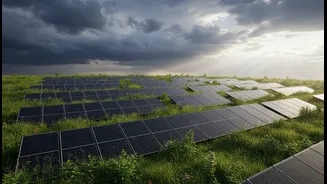
Conventional solar panels, predominantly made from silicon, are impressively resilient, but they are not invincible. Their greatest enemy is often the very thing they need to operate: the sun. Extreme heat, a common feature across much of India, actually
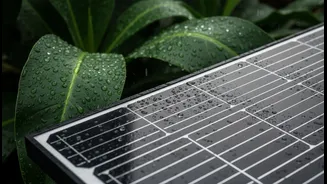
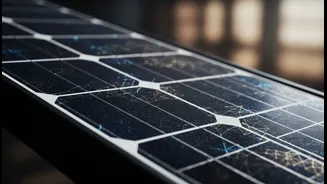
reduces a panel's efficiency. For every degree Celsius above the optimal 25°C, performance can drop. Over time, this thermal stress causes microscopic cracks and accelerates the degradation of materials, slowly chipping away at a panel's power output and lifespan. Then there is the issue of moisture. During the monsoon season, high humidity and rain can lead to water seeping into panels, causing corrosion of electrical contacts and reducing overall reliability. In coastal states, the salty air poses a similar corrosive threat. And perhaps the most persistent issue in many parts of India is dust, which can blanket panels and slash their energy production by as much as 30% if not cleaned regularly.
Enter Perovskites: The High-Potential Challenger
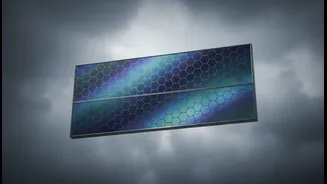
For years, scientists have been excited about a class of materials called perovskites. Named for their specific crystal structure, perovskite solar cells have shown incredible promise in labs. They are potentially cheaper to manufacture than silicon and have achieved stunningly high efficiency levels, sometimes even surpassing their conventional counterparts. This combination of low cost and high performance makes them a prime candidate for the next generation of solar technology. However, perovskites have always had a critical flaw that has prevented their widespread use: they are notoriously fragile. Early versions would degrade rapidly when exposed to real-world conditions like heat, moisture, and even light, making them unsuitable for the 25-year lifespan expected of commercial solar panels. This stability issue was the single biggest barrier holding the technology back from commercialisation.
A Breakthrough in Durability
Now, that barrier is beginning to crumble. Recent breakthroughs from research teams around the world have dramatically improved the durability of perovskite cells, making them far more robust. One innovative approach, developed by researchers in early 2026, involves a technique called "Molecular Press Annealing". This process essentially imprints a protective molecular layer onto the perovskite material as it is being made, which helps to stabilise its structure and prevent the formation of defects that lead to degradation. Another strategy, pioneered by a team at Rice University, involves adding a couple of key chemical additives to the perovskite mix. These additives guide the crystals to form in their most stable and efficient state and help them resist degrading when exposed to heat and humidity. In tests, these enhanced cells have been able to retain over 98% of their initial efficiency even after more than a thousand hours of intense accelerated aging.
The Game-Changer for India's Climate
These innovations are not just academic achievements; they have profound real-world implications, especially for India. A solar panel that is inherently more resistant to heat and humidity is perfectly suited for the country's diverse and demanding climate. Imagine solar farms in the Thar Desert maintaining high efficiency during blistering summer afternoons, or rooftop panels in coastal cities like Mumbai and Chennai resisting corrosion from the humid, salty air. More durable cells would mean a longer effective lifespan and lower maintenance costs, improving the financial viability of solar projects across the board. By making solar power more reliable in challenging conditions, this new technology could accelerate India's transition to clean energy, helping to meet its ambitious renewable energy targets and enhance its energy security in the face of a changing climate.
The Road from Lab to Rooftop
While these developments are incredibly promising, it will still be some time before you can install these next-generation panels on your home. The technology is moving from the laboratory to pilot production lines, with some of the first commercial tandem cells (which pair perovskite with silicon) beginning to ship. However, challenges remain in scaling up manufacturing to the massive levels required to compete with the established silicon industry. Researchers are also working to address environmental concerns related to the use of lead in some perovskite formulas, with many labs exploring lead-free alternatives. Industry experts believe that as these hurdles are cleared, perovskite-based solar panels could become a common sight within the next decade, offering a cheaper, more efficient, and more resilient source of clean power.