



More Than Just Cosmic Clouds
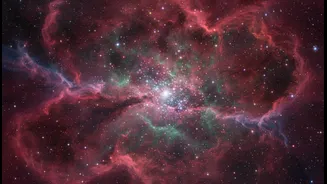
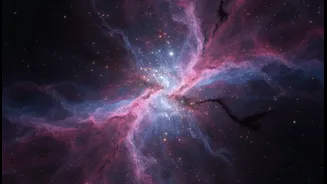
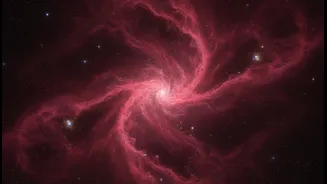
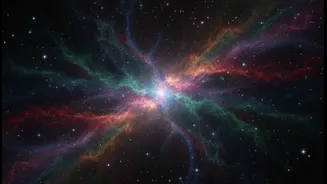
A nebula is a giant cloud of gas and dust in interstellar space. The name comes from the Latin word for 'cloud', as early astronomers saw them as fuzzy patches in the night sky. These immense structures, sometimes spanning hundreds of light-years, are
primarily composed of hydrogen and helium, the most abundant elements in the universe. However, they are also sprinkled with dust and trace amounts of heavier elements. Far from being static, nebulae are incredibly active environments where the epic cycle of stellar life and death plays out. They are broadly classified by how they appear and what they do: some emit their own light, some reflect the light of nearby stars, and some are so dense they appear as dark silhouettes against the starry background.
Stellar Nurseries in Action
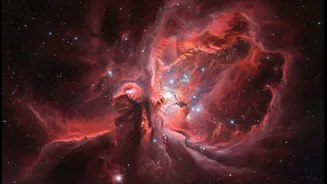
One of the most vital roles of a nebula is serving as a 'stellar nursery'. Within these vast clouds, gravity begins to pull clumps of gas and dust together. As these clumps grow denser, they form a hot, compressed core called a protostar. This early stage of a star's life is a process of accumulation, as the protostar gathers more and more material from a surrounding disc. Eventually, the pressure and temperature at the core become so immense—reaching around 15 million Kelvin—that nuclear fusion ignites. This is the moment a true star is born, releasing a tremendous amount of energy that causes it to shine. The famous Orion Nebula is one such stellar nursery where astronomers can observe this process happening in real-time.
A Universe of Elements
Nebulae are not only the birthplaces of stars; they are also cosmic recycling plants. When massive stars reach the end of their lives, they explode in a spectacular event called a supernova. This explosion scatters all the elements forged in the star's core—such as carbon, oxygen, and iron—out into space. This enriched material then forms a new type of nebula called a supernova remnant, like the well-known Crab Nebula. Over time, this material will be incorporated into the next generation of stars and planets. This means that the heavier elements in our world, in our solar system, and even in our own bodies were created inside a star and distributed by a nebula. We are, quite literally, made of stardust.
Ghosts of Stars Past
Not all stars end with a supernova. When a star like our Sun runs out of fuel, it doesn't explode but instead sheds its outer layers of gas. This expanding shell of gas, illuminated by the hot, dying core of the star, creates what is known as a planetary nebula. The name is a historical misnomer, as they have nothing to do with planets; they just appeared round and planet-like to early astronomers using less powerful telescopes. These beautiful, often symmetrical structures like the Ring Nebula are the graceful 'ghosts' of once-mighty stars, slowly dissipating their material back into the interstellar medium over thousands of years.
The Webb Telescope's New View
Modern telescopes, particularly the James Webb Space Telescope (JWST), have revolutionised our understanding of nebulae. Webb observes the universe in infrared light, which allows it to peer through the dense dust clouds that would otherwise obscure our view. This has given scientists an unprecedented look inside stellar nurseries, revealing individual stars in the process of forming that were previously hidden. The JWST has also allowed for detailed analysis of the chemical composition of nebulae, recently detecting complex organic molecules for the first time, which are key ingredients for understanding the potential for life elsewhere. Images like Webb's 'Cosmic Cliffs' in the Carina Nebula are not just visually spectacular; they are rich data maps showing the intricate interplay between stellar radiation and cosmic gas and dust.