






A New Era for Engineering Education
For decades, aerospace education has relied on a mix of dense textbooks, complex mathematical models, and limited access to physical labs or simulators. While effective, these methods have limitations. Textbooks can’t convey the visceral feel of a struggling
aircraft, and physical simulators are incredibly expensive, difficult to access, and can’t replicate every possible scenario. This is where the concept of the Virtual Reality (VR) classroom, powered by Artificial Intelligence (AI), is not just an upgrade but a complete paradigm shift. It offers a scalable, safe, and profoundly intuitive way to train the next generation of engineers and pilots for one of the world's most demanding industries.
Inside the Virtual Hangar
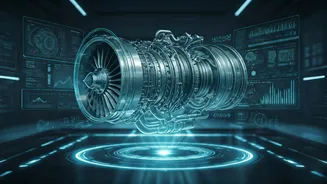
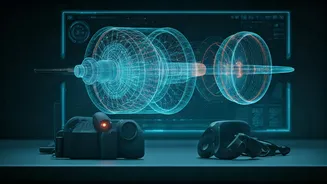
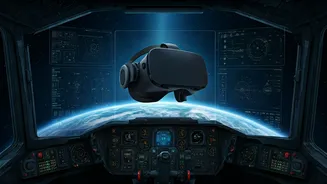
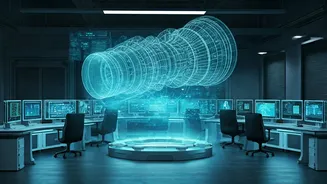
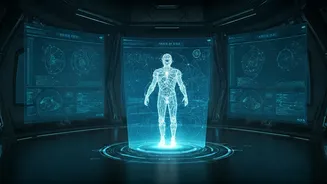
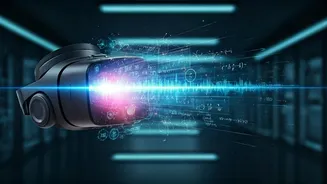
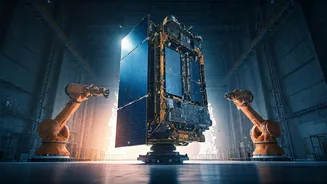
So, what does this virtual classroom look like? A student puts on a VR headset and is instantly transported into a hyper-realistic digital environment. This isn’t a simple video game; it's a 'digital twin'—a physics-accurate, fully interactive replica of a real-world system, be it the cockpit of a fighter jet, the engine of a commercial airliner, or the robotic arm of a space station. Every button, switch, and lever behaves exactly as it would in reality. Using haptic gloves, the student can feel the vibration of an engine or the resistance of a control stick. This immersion creates muscle memory and situational awareness that flat screens can never replicate.
The AI Tutor as a Personal Mentor
The true magic, however, lies with the AI tutor. This is far more than a pop-up help menu. The AI acts as an expert guide, observing the student’s every move within the simulation. If a student misses a critical step in a pre-flight check, the AI doesn't just point it out; it might ask, “What is the purpose of checking the hydraulic pressure at this stage?” It can introduce unexpected failures—an engine fire, a sensor malfunction, a sudden loss of cabin pressure—and analyze the student’s response in real-time. The AI personalizes the difficulty, identifies patterns of error, and provides targeted feedback, ensuring that each learner masters concepts at their own pace. It’s like having a world-class instructor available 24/7, dedicated to one student.
The Power of Learning from 'Safe' Failure
Perhaps the most significant advantage is the ability to train for catastrophic failures in a completely safe environment. In the real world, practicing for a 'one-in-a-million' emergency is nearly impossible. In VR, a student can experience and troubleshoot a dual-engine failure on takeoff dozens of times until the correct response becomes second nature. This freedom to fail and learn without consequence is invaluable. It builds not just competence but also confidence, conditioning engineers and pilots to remain calm and analytical under extreme pressure. This dramatically reduces the cost of training, eliminates the risk to life and expensive equipment, and allows for a depth of practice previously unimaginable.
Implications for India's Aerospace Ambitions
For a nation with soaring aerospace goals like India, this technology is a potential game-changer. As ISRO prepares for ambitious missions like Gaganyaan and private aerospace startups emerge, the demand for highly skilled engineers and technicians is skyrocketing. Integrating AI-driven VR training into the curricula of institutions like the IITs and specialised aviation academies could rapidly accelerate skill development. It can standardise training quality across the country, providing students in any location with access to world-class virtual labs. This would not only give Indian talent a competitive edge globally but also enhance the safety and success of our national aerospace programmes.