




A Sudden, Unprecedented Flash
In late 2019, astronomers at the Zwicky Transient Facility in California noticed something unusual. A previously unremarkable galaxy, known as SDSS1335+0728, located in the Virgo constellation, began to shine brighter than ever before. Unlike temporary
cosmic events like a supernova or a star being torn apart (a tidal disruption event), which last for a few hundred days at most, this galaxy just kept getting brighter. For more than four years now, its core has been undergoing dramatic changes in brightness, a phenomenon scientists have never witnessed in this manner. This sustained and increasing luminosity across ultraviolet, optical, and infrared wavelengths—and more recently, X-rays—pointed to a much more significant event.
What It Means for a Black Hole to 'Wake Up'
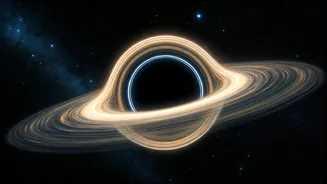
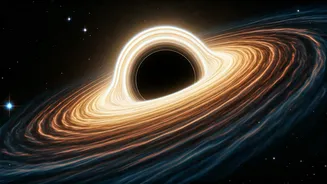
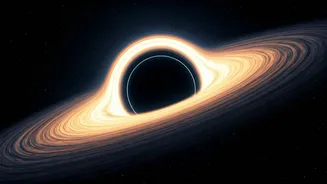
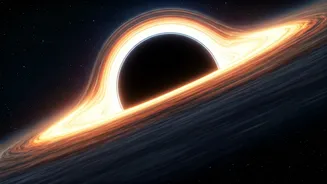
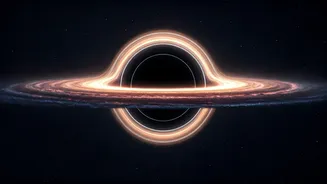
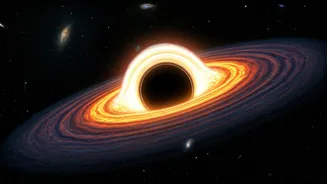
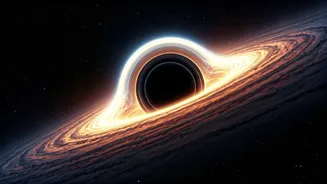
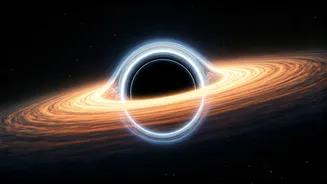
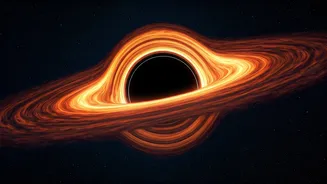
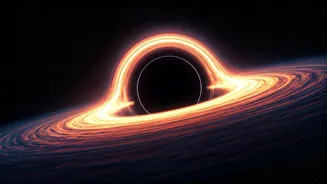
Most large galaxies, including our own Milky Way, have a supermassive black hole at their center, with masses over a hundred thousand times that of our Sun. According to scientists, these cosmic giants are usually 'sleeping' or dormant. A black hole becomes dormant when it has consumed all the nearby gas and stars, leaving nothing within its immediate gravitational reach to feed on. In this state, it is invisible. However, if new material—like a large gas cloud or an unfortunate star—drifts too close, the black hole begins to 'feed' again. The material forms a swirling, superheated disc around the black hole called an accretion disk, which radiates immense amounts of energy and light, causing the galaxy's core to blaze brightly. This newly luminous, feeding state is known as an Active Galactic Nucleus (AGN). What astronomers are seeing with SDSS1335+0728 is the real-time formation of an AGN.
A Cosmic Meal in Progress
The awakening of the black hole in SDSS1335+0728, which is estimated to be about one million times the mass of our sun, is likely due to it beginning to feast on a massive supply of gas in its surroundings. This process of 'waking up' has never been observed directly before. While astronomers have seen galaxies that were active after previously being inactive, witnessing the transition itself is a first. According to Paula Sánchez Sáez, an astronomer at the European Southern Observatory (ESO), this is an unprecedented event. The other leading theory is an unusual and very slow tidal disruption event, but the prolonged and increasing brightness makes the AGN awakening the most plausible explanation for now.
A Rare Opportunity for Science
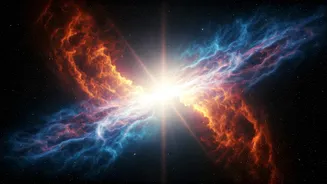
This discovery provides a unique, real-time laboratory for understanding how supermassive black holes grow and influence their galaxies. By tracking the changes in light and energy, scientists can study the formation of the accretion disk and the powerful jets of matter that can be launched from a black hole's poles. Observations are ongoing using a host of ground-based and space telescopes, including the European Southern Observatory's Very Large Telescope. Astronomers hope to piece together how this process unfolds, which could answer fundamental questions about galaxy evolution. The event gives researchers a frontline seat to a process that shapes the cosmos but has, until now, only been understood through theory and observations of black holes that were already active.