


A Sweet Discovery in a Cosmic Cloud
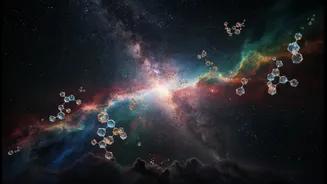
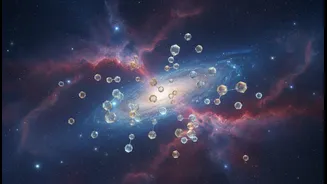
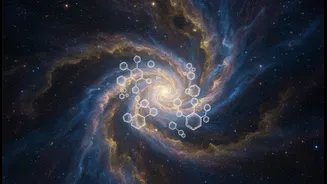
An international team of astronomers has made a landmark discovery, detecting a sugar molecule called erythrulose floating in a massive gas and dust cloud near the center of our Milky Way galaxy. The detection, made using radio telescopes in Spain, marks
the first time a true sugar has been found in the interstellar medium—the material that exists in the space between star systems. The cloud, known as G+0.693-0.027, is roughly 27,000 light-years from Earth and is known to be a rich reservoir of complex organic molecules. Erythrulose is a four-carbon sugar that, here on Earth, is found in things like red raspberries. Finding it in space provides a major clue in the long-standing mystery of how life began.
Solving a Prebiotic Puzzle
For decades, one of the biggest questions in origin-of-life research has been where the first sugars came from. Sugars are fundamental to life as we know it; they form the structural backbone of RNA and DNA and are crucial for metabolic processes that provide energy. However, laboratory experiments simulating the conditions of early Earth have consistently failed to produce sugars in the necessary quantities. This led to a puzzle: if life needs sugars, but they couldn't easily form on our planet, how did biology get started? Scientists had previously found sugars like ribose and glucose in meteorites and asteroid samples, suggesting they might have an extraterrestrial origin. The discovery of erythrulose freely floating in an interstellar cloud strengthens this theory, showing that these vital ingredients can form in space even before planets are born.
A Stepping Stone to RNA and DNA
Erythrulose is more than just a random sugar; it's considered a key prebiotic molecule. While not a direct component of RNA or DNA itself, this four-carbon sugar is a close chemical relative of the molecules that are. In the presence of water, erythrulose can be converted into other sugars, including threose. Threose is believed to be a precursor to some of the earliest genetic systems, potentially predating the RNA-world hypothesis which suggests RNA was the first self-replicating molecule. The presence of erythrulose in space means that a key building block for creating the foundations of genetic material could have been delivered to a young Earth. Researchers estimate that millions of tonnes of this sugar could have rained down on our planet during the Late Heavy Bombardment, a period of intense asteroid and comet impacts billions of years ago. This cosmic delivery could have supplied the "prebiotic soup" with the ingredients needed for life's first stirrings.
An Unexpected Chemical Factory
The discovery was also surprising for another reason. Prevailing theories in astrochemistry suggested that complex molecules in space form by sequentially adding one carbon atom at a time. Following this logic, astronomers expected to find simpler, three-carbon sugars before finding a more complex four-carbon one like erythrulose. Yet, sensitive searches of the same molecular cloud found no trace of the simpler sugars. In fact, erythrulose appears to be at least eight times more abundant than any potential three-carbon sugars. This suggests that the chemical processes in these cold, dense clouds might be different than previously thought. The leading hypothesis now is that erythrulose forms when two simpler, two-carbon molecules combine on the surface of icy dust grains, bypassing the one-carbon-at-a-time route entirely. This finding paints interstellar clouds as even more efficient chemical factories than we knew.
The Search for Life's Ingredients Continues
Detecting erythrulose is a monumental step, but it’s not the end of the story. The finding demonstrates that biologically important molecules can form in the harsh conditions of space and become part of the material from which new stars and planets form. Scientists are now hopeful that they can find other, even more significant sugars, such as ribose—the 'R' in RNA. The discovery of erythrulose serves as a vital marker, showing astronomers what to look for and proving that the cosmic ingredients for life might be scattered throughout the galaxy. By studying these interstellar nurseries, we get a glimpse into the chemical starting conditions not just for our own solar system, but for countless other planetary systems that may one day host life.