




A New Cosmic Surveyor
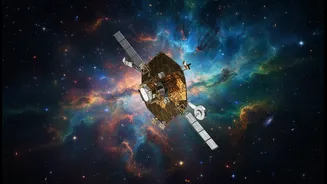
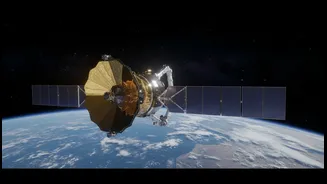
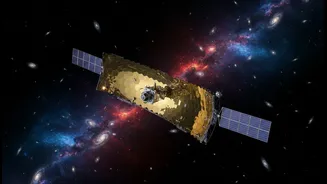
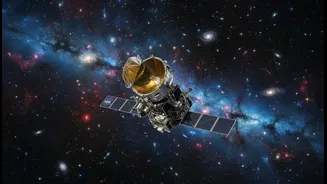
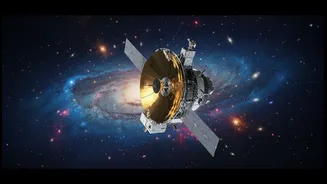
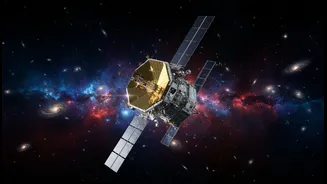
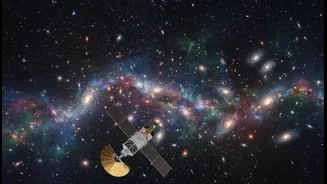
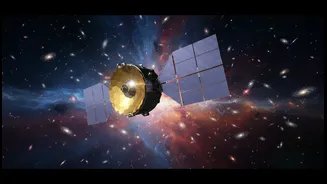
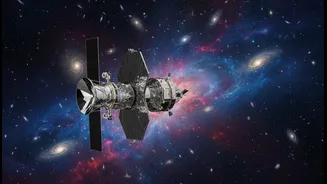
Scheduled to launch aboard a SpaceX Falcon Heavy rocket on August 30, 2026, the Nancy Grace Roman Space Telescope is NASA's next great observatory. Named after the agency's first chief of astronomy, this powerful telescope isn't designed to replace its
famous predecessors like Hubble or Webb. Instead, it's a cosmic surveyor. Its primary mission is to capture enormous, panoramic images of the universe with unprecedented speed and efficiency. With a primary mirror the same size as Hubble's (2.4 meters), Roman has been engineered for a completely different task: creating vast maps of the night sky in infrared light, the key to unlocking some of science's most profound mysteries.
The Power of a Panoramic View
Roman's transformative power lies in its incredible field of view. Its Wide Field Instrument can capture an area of the sky more than 100 times larger than Hubble can in a single snapshot, all while maintaining a similar, stunning image quality. To put that in perspective, where Hubble would need to take hundreds of individual photos to create a mosaic of our neighboring Andromeda galaxy, Roman could do it in just two. This ability to survey the sky at a rate up to 1,000 times faster than Hubble will generate a treasure trove of data, allowing astronomers to study the cosmos on a grand, statistical scale that was previously impossible.
Solving the Dark Universe Riddle
Approximately 95% of the universe is composed of dark matter and dark energy, mysterious components that we can't see or directly detect. Roman's primary science objective is to tackle this enigma head-on. By surveying billions of galaxies and thousands of exploding stars called supernovae, the telescope will measure how the universe's expansion has changed over cosmic time. These measurements will help scientists determine the nature of dark energy—the force thought to be accelerating the expansion of the universe. Roman will also map the distribution of dark matter by observing how its gravity bends the light from distant galaxies, a phenomenon known as weak gravitational lensing.
A Census of Alien Worlds
Beyond cosmology, Roman is poised to revolutionize the hunt for exoplanets—planets outside our solar system. While missions like Kepler found thousands of planets by looking for the dimming of starlight (transits), Roman will primarily use a different technique called gravitational microlensing. This method can detect planets far more distant than other techniques, including smaller, Earth-mass worlds and even rogue planets that drift through space without a host star. By staring toward the dense center of our Milky Way, astronomers expect Roman to discover on the order of 100,000 new exoplanets, creating a massive census that will help us understand how common planets like our own truly are in the galaxy.
The Ultimate Team Player
Roman is not a lone wolf; it's a team player. Its strength lies in its synergy with other observatories. Roman's rapid, wide-angle surveys will act as a massive cosmic finder chart, identifying unique and fascinating objects for other telescopes to investigate further. Once Roman flags an interesting target—be it a rare type of galaxy, a distant supernova, or a potentially habitable exoplanet—the powerful and precise instruments of the James Webb Space Telescope or the Hubble Space Telescope can be used for detailed follow-up observations. This one-two punch, combining Roman’s panoramic search capabilities with Webb’s deep-dive analysis, will allow scientists to paint the most complete picture of our universe to date.