


A Family of Captured Misfits
Planetary moons typically come in two varieties. 'Regular' moons are thought to have formed from the same disk of gas and dust as their parent planet, circling in neat, equatorial orbits. Then there are 'irregular' moons. These are the rebels of the satellite
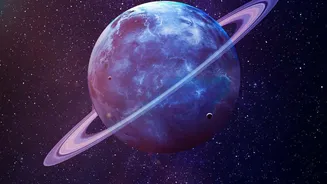
world, believed to be stray objects from elsewhere that were captured by a planet’s gravity long ago. They tend to have large, tilted, and elliptical orbits. Uranus has a whole collection of these captured moons, most of which were discovered in the last few decades. These small, dark bodies are like cosmic fossils, offering a glimpse into the conditions of the early solar system when gravitational interactions were far more chaotic.
Margaret: The Moon Going the 'Wrong' Way
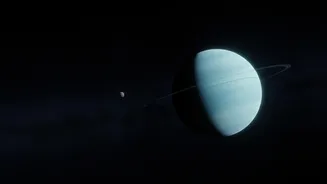
Among Uranus’s irregular moons, one stands out: Margaret. Discovered in 2003, this tiny moon, only about 20 kilometers in diameter, has an orbit unlike any of its peers. While the other nine known irregular moons of Uranus travel in a retrograde direction—orbiting opposite to the planet's rotation—Margaret is the only one with a prograde orbit, moving in the same direction as Uranus spins. This makes it a true anomaly. Imagine a busy roundabout with all but one car driving clockwise; Margaret is that lone car going counter-clockwise against the established traffic pattern of its cohort. This solitary path makes it an object of intense scientific curiosity.
A Fossil from the Solar System's Youth
So why does one tiny moon's strange path matter? Because it provides a crucial test for our theories about how planetary systems form and evolve. The leading theory suggests that irregular moons were captured during a tumultuous period in the solar system's history, possibly when the giant planets were migrating and scattering smaller icy bodies from the Kuiper Belt. However, capturing a moon is a delicate gravitational dance. The existence of a single prograde moon like Margaret among a family of retrograde ones puts tight constraints on what those capture mechanisms could have been. Did they all get captured at once, or in separate events? Margaret's orbit, which is also highly eccentric and inclined, is a preserved clue from this chaotic era billions of years ago, helping scientists refine their models of planetary formation.
Unlocking the Secrets of an Ice Giant
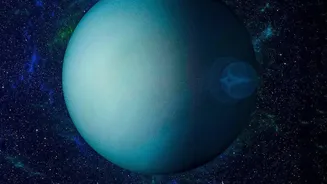
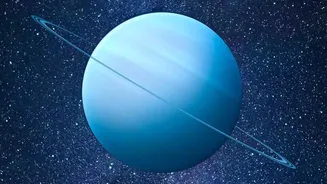
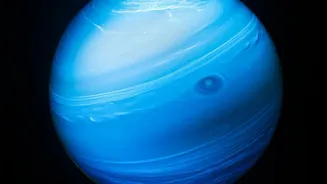
Studying Margaret doesn’t just tell us about the past; it also helps us understand the Uranian system as it is today. Uranus itself is a mystery, likely knocked onto its side by a colossal impact with an Earth-sized object in its distant past. Understanding the orbits of its moons—both regular and irregular—helps piece together the story of that impact and its aftermath. Margaret's unique orbit could be dynamically unstable over very long periods, potentially providing insight into the long-term evolution of satellite systems. It’s a tiny but vital piece of a much larger puzzle. The more we learn about this outlier, the clearer our picture becomes of the forces that shaped this distant ice giant and its extensive family of moons.