




An Orbital Junkyard
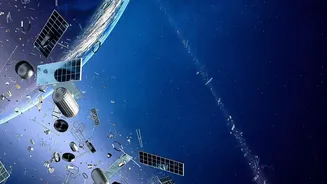
Low Earth Orbit (LEO) is an invisible but essential part of our global infrastructure. It's home to thousands of satellites that provide everything from GPS navigation and weather forecasting to global communications. But there's a growing problem: space
junk. Decades of launches have left behind a cloud of debris, from tiny paint flecks to entire defunct satellites. According to the European Space Agency, there are millions of debris objects orbiting Earth. Even small fragments, travelling at speeds over 28,000 kilometres per hour, can inflict catastrophic damage on active satellites. This creates a risk of a chain reaction known as the Kessler Syndrome, where one collision creates more debris, leading to more collisions, potentially rendering LEO unusable for generations.
The Cleanup Crew Arrives
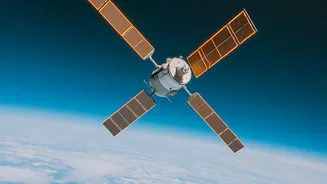
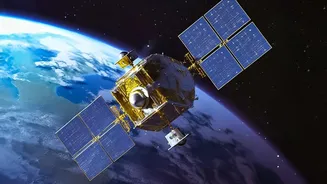
To prevent this scenario, a new industry is taking shape: Active Debris Removal (ADR). Companies and space agencies are developing innovative 'servicer' spacecraft designed to hunt down, capture, and safely de-orbit the most dangerous pieces of junk. Several methods are being tested, including nets, harpoons, and robotic arms. However, one of the most promising approaches involves the use of magnetism. This method offers a way to gently capture a target without generating more debris, a key advantage when dealing with fragile or tumbling objects in the harsh environment of space.
Magnetic Grappling Explained
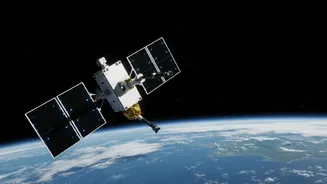
The most straightforward magnetic capture system involves a servicer spacecraft equipped with a powerful electromagnet. The primary model for this technology requires future satellites to be built with a specific ferromagnetic 'docking plate'. A company pioneering this method is Astroscale, whose ELSA-d mission successfully demonstrated this concept in orbit. The process works like a high-tech tow truck. The servicer satellite would approach a defunct satellite, extend a magnetic grappling mechanism, and lock onto the docking plate. Once securely attached, the servicer can use its own thrusters to push the captured junk into a lower orbit, causing it to re-enter and burn up harmlessly in Earth's atmosphere.
Tackling Non-Magnetic Junk
But what about the tens of thousands of debris objects already in orbit that lack a special docking plate? A significant portion of space debris is made from non-magnetic materials like aluminium. For these targets, researchers are developing more advanced techniques. One method uses powerful, rotating magnetic fields to induce electrical currents, called eddy currents, within the conductive material of the debris. These currents create their own magnetic field, which the servicer probe can then interact with. This allows the probe to exert a force to slow a tumbling object without physically touching it, making a subsequent capture safer and easier.
The Promise of Electrodynamic Tethers
Another advanced concept is the electrodynamic tether. This involves a long, electrically conductive cable that is attached to a piece of debris. As the tether moves through the Earth's magnetic field, it generates an electrical current. This interaction creates a drag force that slows the object down, causing its orbit to decay much faster than it would naturally. This method is compelling because it uses the natural space environment for propulsion and doesn't require the servicer to expend large amounts of its own fuel to drag the debris down. However, these long tethers are also vulnerable to being severed by smaller, untracked debris.
Challenges and the Road Ahead
While magnetic capture technology is rapidly advancing, significant hurdles remain. The main challenge for the simple magnetic plate system is that it only works on future satellites designed with compatible hardware. For the millions of pieces of existing debris, more complex and expensive non-contact methods are required. The legal and financial questions are also complex: who is responsible for cleaning up old satellites, and who pays for it? Despite these challenges, companies like Astroscale, ClearSpace, and others are forging ahead, developing the business models and technologies that will become essential for maintaining a safe and sustainable orbital environment.