






An Invisible Threat from 93 Million Miles Away
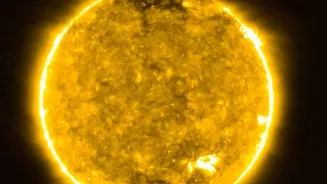
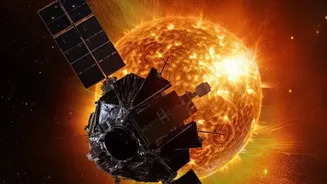
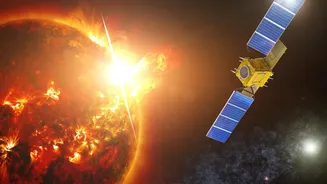
We often think of weather as a local, atmospheric event. But there's another kind of weather that originates from the sun, and its effects can be felt right here on Earth. 'Space weather' refers to the changing conditions in space driven by the sun's
activity. This includes dramatic events like solar flares—immense explosions on the sun's surface—and coronal mass ejections (CMEs), which are massive clouds of charged particles hurled into space. When these events are directed towards Earth, they can have significant consequences for our technology-dependent society. While they can produce beautiful auroras, they also carry the potential to disrupt everything from power grids to the satellite systems we depend on daily.
How the Sun Can Jam Your GPS
Your phone or car's GPS receiver works by triangulating its position from signals sent by a constellation of satellites. For this to be accurate, those signals must travel from space to your device unimpeded and at a predictable speed. Space weather disrupts this delicate process by disturbing the ionosphere, a layer of Earth's upper atmosphere full of charged particles. When a solar storm hits, it can drastically increase the density and turbulence of the ionosphere. This causes the GPS radio signals passing through it to bend, slow down, or fluctuate wildly—a phenomenon called 'scintillation'. This scintillation is like trying to see the bottom of a pool through choppy water; the image gets distorted. For a GPS receiver, this distortion can introduce positioning errors of tens of meters or, in severe cases, cause a complete loss of signal lock.
Earth's Early Warning System
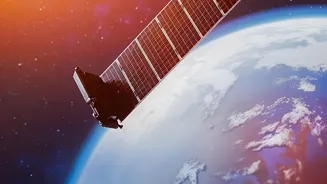
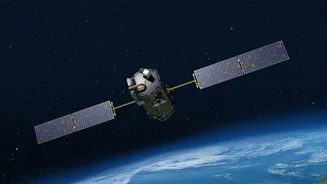
This is where ground observatories become crucial. While satellites in space provide vital, direct measurements of the sun and solar wind, a global network of ground-based instruments offers a continuous, detailed view of how Earth's magnetic field and ionosphere are responding in real-time. This network includes magnetometers that detect fluctuations in our planet's magnetic field and specialised GNSS receivers designed to measure ionospheric scintillation. In India, for instance, the Indian Network for Space Weather Impact Monitoring (InSWIM) program, initiated by ISRO, uses a network of GNSS receivers, magnetometers, and other instruments to monitor the unique ionospheric conditions over the region and develop models to mitigate errors. This data provides the raw material for space weather forecasters.
From Raw Data to Actionable Alerts
Data from ground observatories, combined with satellite data, flows into forecasting centres like the Space Weather Prediction Center (SWPC) in the US. Forecasters analyse this information to issue alerts, watches, and warnings, much like meteorologists do for terrestrial weather. These alerts give critical sectors time to prepare for potential disruptions. An alert might warn that ionospheric conditions over a specific region are likely to cause significant GPS degradation for the next several hours. This allows industries that rely on centimetre-level accuracy to pause sensitive operations, switch to backup systems, or prepare for inaccuracies. Without this ground-based, real-time monitoring, we would only know the extent of the disruption after it had already caused problems.
Keeping Critical Industries Online
The impact of these alerts is enormous. In aviation, airlines can reroute flights, especially those over polar regions where space weather effects are strongest, to avoid communication blackouts and ensure navigation systems remain reliable. The precision agriculture industry, which uses GPS-guided tractors for planting and fertilising, can avoid costly errors that could result from a sudden loss of accuracy during a solar storm. A storm in May 2024 was estimated to have cost US farmers over $500 million due to navigation disruptions during planting season. Shipping, surveying, construction, and even financial markets that rely on GPS for precise time-stamping all benefit from the heads-up that space weather alerts provide, allowing them to implement mitigation strategies before a storm hits its peak.