



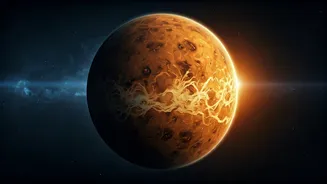



The Ultimate Cosmic Riddle
On Earth, our sense of time is dictated by two simple planetary motions: our planet spins on its axis once to give us a day, and it orbits the Sun once to give us a year. A year is made of roughly 365 days. It’s intuitive. Venus, often called Earth’s
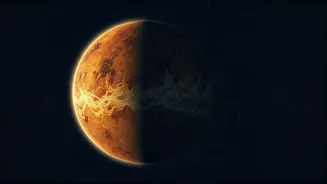
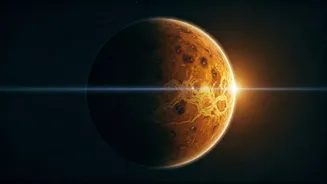
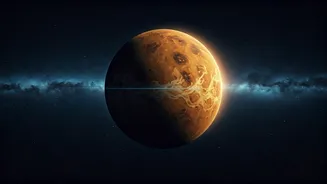
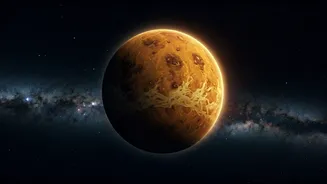
“twin” for its similar size and mass, throws this entire concept out the window. The headline isn’t just a catchy phrase; it's a literal description of the planet’s bizarre timing. A single day on Venus is longer than its entire year. To understand this, we have to redefine what we mean by a “day” and a “year” on this scorching, inhospitable world.
A Day Versus a Year in Numbers
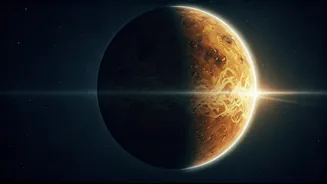
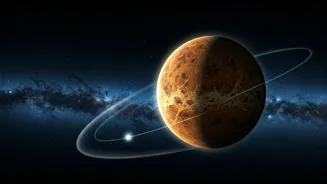
Let’s break it down using Earth days as our reference. A year on Venus—the time it takes to complete one full orbit around the Sun—is about 225 Earth days. This is shorter than Earth’s year, as Venus is closer to the Sun. Now for the tricky part: the day. A planet’s “sidereal day” is the time it takes to complete one full 360-degree rotation on its axis. For Venus, this takes a mind-boggling 243 Earth days. That’s right: one spin of the planet takes longer than one trip around the Sun. This means if you were standing on Venus, the planet would complete its yearly journey before it even finished a single rotation. As a result of this slow, backward spin, a “solar day” on Venus (the time from one sunrise to the next) is about 117 Earth days. So you’d wait nearly four Earth months for the sun to set after it rises.
Why the Incredibly Slow, Backward Spin?
Scientists have two main theories to explain Venus’s strange behaviour. The first is the “giant impact” theory. Early in the solar system’s history, a period of violent collisions, it’s possible that Venus was struck by a massive planet-sized object. Such an impact could have been powerful enough to not only slow its rotation to a crawl but actually reverse its direction. This would explain its “retrograde” rotation—Venus spins clockwise, while most other planets, including Earth, spin counter-clockwise.
The second, and increasingly popular, theory points to Venus’s own suffocating atmosphere. Venus is shrouded in a thick, heavy blanket of carbon dioxide, with pressures on the surface over 90 times that of Earth’s. This atmosphere is a dynamic, powerful force in its own right.
An Atmosphere That Acts Like a Brake
Venus's atmosphere doesn't just sit there; it spins incredibly fast, whipping around the planet in just four Earth days in what is known as “super-rotation.” This creates powerful tidal forces, not from a moon, but from the atmosphere itself. Imagine the immense friction and drag this creates on the planet's surface. Over billions of years, scientists believe this atmospheric tide could have acted as a massive braking system, slowing the planet's spin and eventually locking its solid core into a delicate balance with its churning atmosphere. Recent models and radar observations from missions like Magellan and Venus Express support this idea, showing how the friction between the fast-moving clouds and the slow-moving mountains below could be enough to govern the planet's rotation speed.
What It Would Be Like on the Surface
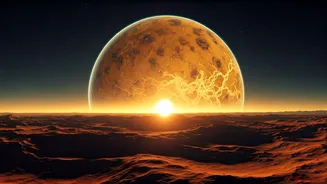
The consequences of this slow rotation contribute to Venus’s hellish environment. With a day lasting months, the sun-facing side bakes for an extended period, contributing to surface temperatures hot enough to melt lead (around 465°C). The sun would rise in the west and set in the east, moving across the sky at an excruciatingly slow pace. The long nights don’t offer much relief, as the thick atmosphere traps heat like a runaway greenhouse, keeping the night side almost as hot as the day side. It’s a world without the familiar rhythm of day and night, locked in a perpetual, planet-wide heatwave, all because it forgot how to spin properly.