







The End of Business as Usual
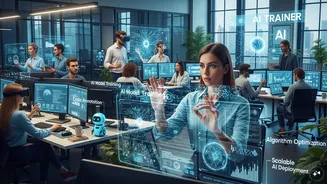
For years, artificial intelligence at work was a specialized tool, handled by data scientists and IT teams. Today, generative AI has broken out of the lab and is embedded in everyday software, transforming how we work. [17] This shift from a niche technology
to a general-purpose one means AI is no longer something happening 'over there'—it's here, on everyone's screen. The rapid introduction of multiple AI tools is creating pressure for employees, with adoption accelerating faster than many expected. [9, 17] This isn't just another software update; it’s a fundamental change to the nature of professional work, impacting roles from content creation to customer service. [17]
The Anxiety Is Real—and Justified
The primary concern for many is job security. Globally, AI is projected to affect over 300 million full-time jobs by 2030, with some studies showing that nearly a quarter of U.S. companies have already replaced workers with AI tools. [10, 17] In India, where a significant portion of the workforce is in the tech sector, the disruption is keenly felt, with employees believing over half their jobs could be automated. [7] Yet, the 'problem' is more complex than just job losses. Many employees report a disconnect with their employers, who see AI as a positive tool, while workers worry about its impact. [15] There's also the threat of 'role compression', where AI automates the interesting parts of a job, leaving employees with lower-status tasks and threatening their sense of expertise. [11]
A Disconnect Between Strategy and Reality
While companies are rapidly investing in AI, there's a growing gap between strategy and execution. A recent global study found that while AI adoption is surging, only 23% of leaders believe their workforce is fully ready for it—a drop from the previous year. [26] Employees feel this gap acutely. Many feel pressured to use AI without adequate training, leading to frustration and even 'shadow AI' use that poses security risks. [21, 23] Furthermore, there is a clear disconnect in perception: while 71% of employers view AI positively, only 51% of employees agree. [15] This highlights a failure not of technology, but of change management. The challenge for businesses is no longer just implementing AI, but managing the human transition that comes with it. [24]
The New Core Skill: AI Fluency
The solution isn't to resist AI, but to adapt. The consensus is that upskilling is no longer optional; it's essential for survival. [3, 18] In India, there's a significant push for AI skilling, with the government and companies alike recognising its urgency. [16, 19] Experts predict that by 2025, over 60% of jobs in India will require significant AI proficiency. [3] This doesn't mean everyone needs to become a coder. The new crucial skills include AI literacy, prompt engineering, data-driven decision making, and the uniquely human skills of critical thinking and creative judgment. [3, 17] The goal is to create a hybrid intelligence where humans and AI collaborate, with employees learning when to trust AI, when to challenge it, and how to use it to amplify their own capabilities. [9, 24]
Whose Problem Is It to Solve?
The responsibility for navigating this transition is shared. For employees, it means embracing a mindset of continuous learning. But the onus isn't solely on them. Companies have a critical role to play in providing robust training, redesigning roles thoughtfully, and creating a culture where employees feel safe to experiment and even question AI outputs. [18, 24] Leaders must move beyond simply deploying tools and focus on the human side of the change, managing the anxieties and expectations of their workforce. [11, 24] For India, this involves a collective effort between government, industry, and academia to embed AI literacy across the entire skilling ecosystem, ensuring the workforce is prepared for a future that is already here. [19]